
Bitterest Day, Sakura Arms
Week of February 23rd, 2026

In our ASL games we’ve been progressing through the Okinawa scenarios in Heat of Battle’s Bitterest Day, and this week ended up in BD-8, Crescent Carnage. After 3 days of unsuccessful battles, the Marines decide to get serious and attack Half Moon Hill with a combination of a) adequate force, and b) a flamethrowing tank. My tactical tip here would have been that if a flamethrowing tank was available, I’d have started with that instead of waiting until day 3 (maybe it was stuck in traffic). After our first three scenarios had been mostly blowouts one way or the other, this was our first really intense game that ended up in a short-range firefight on top of the hill as the Japanese infiltrated back into the flanks and rear through hidden cave exits. It was nasty and it felt very historical.
Assaulting these fortified cave complexes is tough and very dependent on access to specialized equipment: white phosphorous and flamethrowers particularly (the use of either is a borderline war crime; white phosphorous is especially brutal and its use is now kind-of-sort-of-illegal). In ASL, both of these are subject to (structured) random availability. In the first cave scenario I played as the attackers, it turns out I had none of either; that makes that scenario really hard. Flamethrowers particularly have a 1-in-6 to 1-in-12 chance of depletion on each shot. Whether these weapons show up or not has an outsized impact on the game.
I’ve talked about the emotional challenges of playing ASL scenarios in the past, since it’s a pretty intense game. In this particular assault on Half Moon Hill, both of my crucial weapons — the flamethrowing tank and my ranking 9-2 leader — played no role in the battle as they each rolled boxcars and fated out. The tank ran out of fuel for before landing a shot, and the 9-2 leader was wounded on first sight of the enemy. That is a really rough way to start out. It can take an effort of will to keep going. It had me wondering, what am I even doing here?
As I was considering the game on the way home, I found myself contemplating the connection to one of my least favorite composers: Gustav Mahler. Mahler famously said to Sibelius, “The symphony must be like the world; it must embrace everything”. This is, I think, kind of why his music does nothing for me. He thought music should reflect the real world (or his world anyway, which maybe is my greater objection) not just in its seriousness but also in its incoherence and banality. Not just triumph or despair or longing or grief, but also being stuck in traffic staring at brake-lights. The thing is, I spend most of my time in the real world. I have to say, the real world has a lot of issues. I go the concert hall for something else. People who are much smarter than me love Mahler, so what do I know, but speaking personally I can appreciate a pretty wide range of music but I actually find Mahler’s profligacy and inanity triggering despite its sometime beauty and lyricism.
That malfunction of the flamethrower is a Mahler-esque moment. It’s a thing that happened. It’s real. It defies any sense of narrative in a form that is ultimately narrative. It’s a Chekov’s Gun that never fires. It makes you feel bad. It’s a moment of despair that leads nowhere but, probably, more despair. It destroys any sense of game balance.
The undeniable truth though is that Bitterest Day speaks to me and Mahler doesn’t. What does this say about me, I wonder? Scenario BD-8 Crescent Carnage and Mahler’s Symphony #1 are not wildly different things. They’re both narrative forms, designed or composed to reflect the human struggle to process the world. Maybe you don’t think ASL rises to that level of art, but I do: it’s a product of a bunch of design choices that focus tightly on human experiences and portrays them in a curated and structured way that elicits an emotional response. The crucial thing, and the thing that points to why I believe games are underestimated as art, is that ASL gives me agency. When Mahler is going on one of his weird tangents, I just have to sit there and take it. When things go wildly sideways on turn 1 of Crescent Carnage, my choices about how to respond matter. I can choose to hang on to hope, I can value perseverance in the face of adversity, I can stick to my values of sportsmanship. I can do the best that I can do and recognize that has value. I can do this knowing that the rules of narrative don’t apply and that the game doesn’t reward these things any more than life does. ASL has no catch-up mechanism. I suppose I could respond the same way to Mahler, but in ASL, my response becomes part of the art and to me that gives it meaning.
Now as often as not, in ASL you stick with it and the world just keeps hammering you because that’s how the world works and so that’s what’s likely to happen. Then you start making poor choices out of an entirely human sense of frustration and injustice, and things end up going badly. Especially in a game about violence, where in the original context losing your cool would lead to other people getting killed, this may not be entirely emotionally healthy. I think this may be the root of my ambivalent feelings about this whole genre. If the games aren’t raw enough to make you feel bad often enough to be uncomfortable, then they aren’t doing their job. But in 2026, who wants to feel bad as the result of playing a game? The real world gives us more than enough to feel bad about.
So here we are. I played this scenario. There were chunks of the experience that felt bad. I didn’t love that. A crisis of modernity is that we’ve been told that our individuality is paramount, but at the same time we often feels powerless and, more often than we’d like to admit, expendable. Playing a game that puts you in the middle of an evocative, life-or-death crisis and then makes you feel powerless may not be what sanity requires in this moment. The connection through history to a world in deep crisis and to the people who through no fault of their own had to find a way to deal with it is, I think, a worthwhile thing. But it isn’t, and should not be, free.
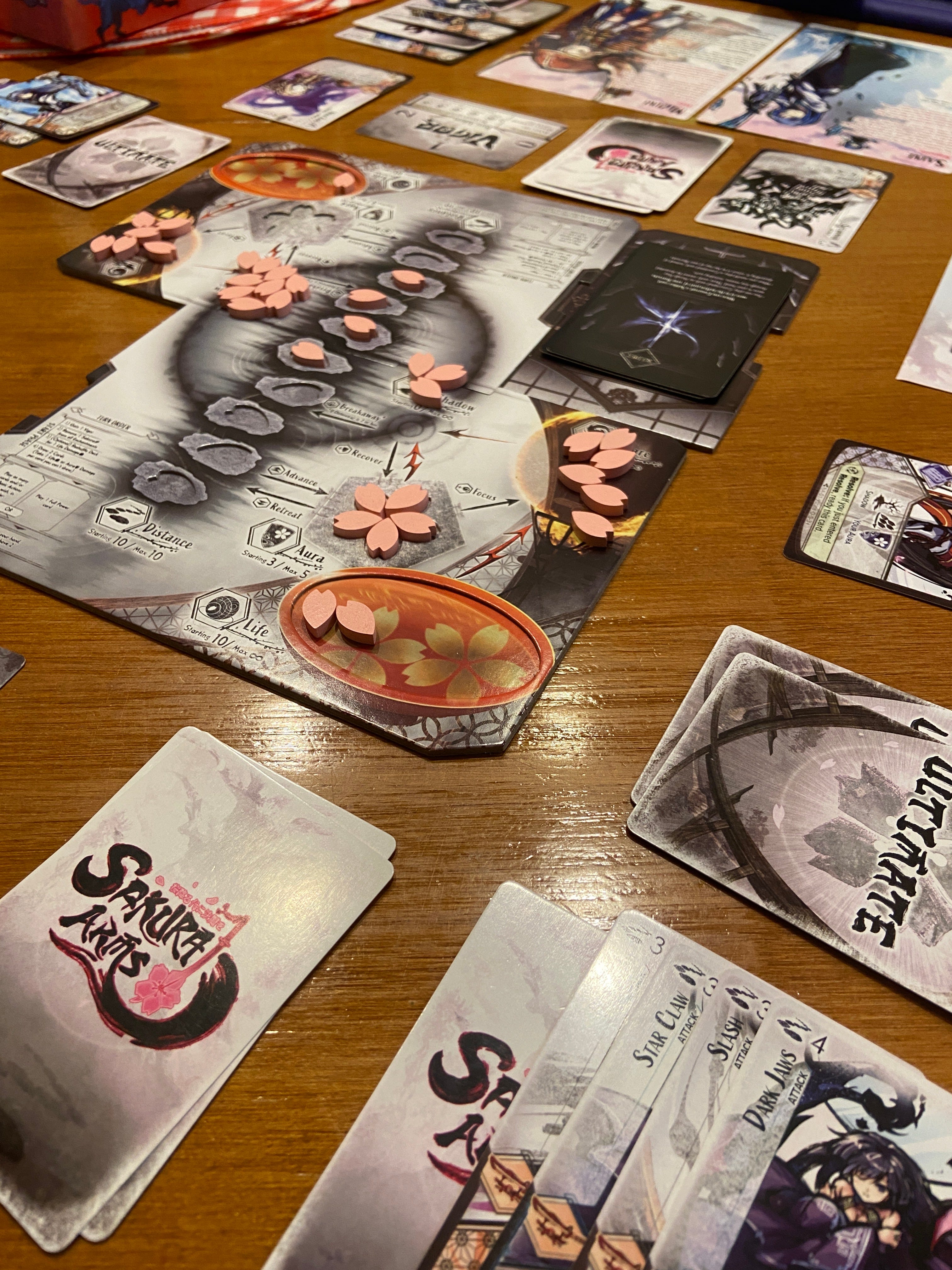
Sakura Arms is a game I adore but almost never get to play. The source of its visceral appeal to me isn’t totally clear, to be honest. I was talking with a friend at the Guildhouse recently, and she was saying how she really enjoyed Molly House and Tragedy Looper because of how they forced her to think in different ways than traditional euros. Sakura Arms certainly has a little bit of that going on; the Smash-Up like combinations of the different goddesses can result in wildly different play styles and like other highly-tractable games of this sort (Blue Moon comes to mind) there is a lot of avenue for creative play. It’s also true that it’s a distinctively Japanese minimalist design, a deckbuilder where you’re building 7 card decks. When it works — when it’s simultaneously clean and also has plenty of nuance, which doesn’t happen all that often — I really like that style. That’s all great, and I can make a system-design case for it as a really good, very thoughtful and engaging, game. I suspect my affection for the game is more basic though. I just like the variety, I like the characters who are colorfully and humanely drawn and very diverse. And I like the sense of accessible mastery. It provides you with a lot of things to master and you feel like you’re learning stuff each game, but the mastery curve isn’t particularly punishing. It’s not like Up Front or Race for the Galaxy or Brass where you have to play a bunch of games feeling incompetent before the game starts to click.
Having said this though, it is still a game that rewards investment. Playing and learning to master the pre-configured Smash Up-style decks is fine and entertaining but not super-deep and the real draw here is the huge and diverse game-world made tractable through deck-building. My current mode of play, which is doing a couple duels occasionally using the simpler goddesses when I can talk someone into it, is not the most fulfilling way to engage with the game. Not for me anyway; I want to explore the higher levels of mastery. So we’ll see. Maybe someday.
Coda
Reena Esmail is a contemporary American composer who has written a good amount of nice clarinet music. I had been vaguely aware of her but only really discovered her when my orchestra played her piece Avartan which charmed me. Reading her bio, it seems she really only discovered her compositional voice when she blended her western classical training with her Hindustani heritage. I’ve enjoyed her music, and as a player I like that it’s accessible not just to listeners but to amateur performers. She has a couple short pieces that I’ve added to my library and maybe I’ll play someday.
Thanks for reading! Don’t forget to like, subscribe, and share, and see you next week!
This is a deep one.