
Compania, Root: Marauder, Ascension Legends, ASL: Chef du Pont
Week of March 23rd, 2026

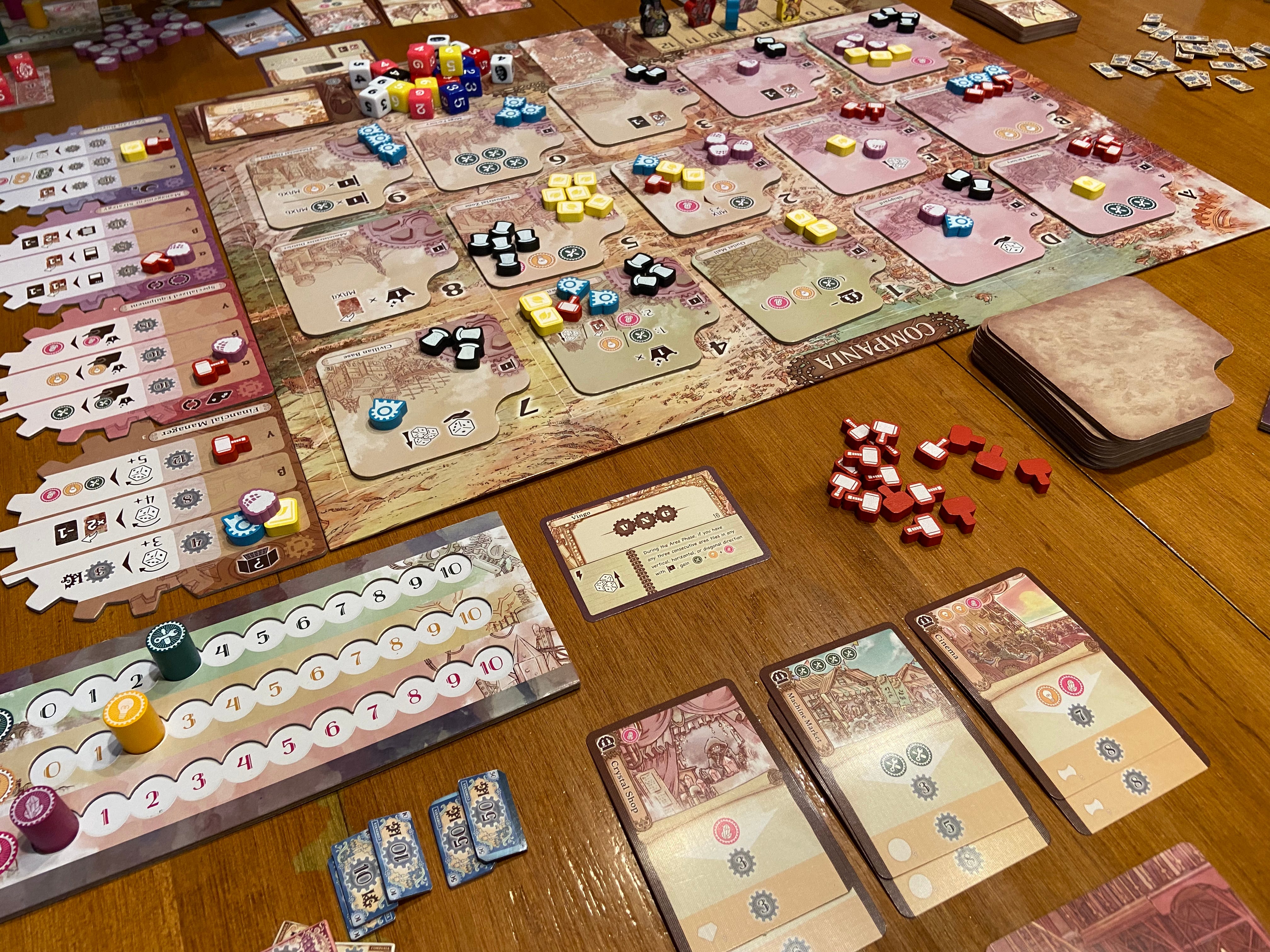
Compania is an interesting game for me these days. It’s totally abstract; while there is the occasional 2-player abstract that I think is great, when it comes to euro-style hobbyist games I’ve come to think of theming as an essential component at some level. Compania is so lightly themed as to be non-existent (there is some kind of Steampunk backstory that makes almost no impression at all on you while you’re playing). And it’s an economic game. As I went on about at some length last week, I don’t hate games about capitalism but we sure do have a lot of them and they are sometimes hard to distinguish. I’ve got Amun-Re and Yokohama and Power Grid: Outpost, I don’t need a ton more. But Compania is also from Japanese designer Akase Yog, and wow, it brings a lot that is unique to the table. To the point that when someone asks “what’s it like?”, it’s almost impossible to answer. It’s got tableau-building, but it’s not really a tableau-builder. It’s got simultaneous bidding and area-control, but the context for both of those is very unusual. It’s got worker placement in the literal sense that you place workers, but it’s not a worker placement game. Plus it’s fast and absurdly tight. So of course I think it’s great.
The core mechanic here is that everyone is secretly and simultaneously allocating their workers (5 at start) to buildings (6 at start, with one more added each turn over 9 turns). Initially, players can only allocate to 3 different buildings. Only the player(s) with the most workers present get to activate the building, although everyone else will save their workers for future turns. The buildings offer powers like gaining resources, gaining workers, drawing cards, fiddling resources, or gaining additional placements. After that, everyone can play cards from their hands into their tableaux, which are mostly factories that convert resources into money (charmingly called “kilogold” by the game, aka victory points). There are other cards which can convert board state (usually how many buildings you won this turn) into points, and everything can be upgraded over time to produce points more efficiently. You can also buy special powers, which may involve getting to buy resources for cash every turn instead of having to rely on taking your chances with the buildings, getting kickbacks from playing cards, bonuses when you control buildings, or a variety of other rotating abilities.
Compania may be abstract, but it has another feature that I love: it just does not screw around. At all. It is Knizian in its ease of explanation and leveraging systems into high-stakes decisions. Knizia usually does not do logistical games like this though (convert workers into resources into buildings into victory points) so it feels different. The core gameplay elements are largely simultaneous so it’s really efficient with the players’ time. The game only goes about an hour, and yet it takes you on a journey from the first few turns of “how the heck am I ever going to get anything done” and scoring your first 15 points or so on turn 3 or 4 to a final score of a couple hundred points at the end of turn 9.
It’s also pretty intense. It is, at its core, a market-efficiency game. The three resources in the game (known affectionately by players in my games as green, yellow, and pink but theoretically machines, electricity, and crystal) are going to be in variable supply and demand based on what buildings come out in what order and which Transaction cards (which exchange resources for kilogold) players build. You can look around the table and get a read for what people want based on what they’ve built and what they have in storage, although you can’t see their hand and what their future potential might be. You can use this information to bid, but it’s all a bit fuzzy because you’re up against worker and building placement limits. Plus about a third of the economy probably doesn’t work this way, in the Area cards which pay off for building control. Plus you’ve got your faction enhancements through getting more workers or more placements or special powers. There is a lot going on for a very elegant superstructure. And after your first game, you can add even more (which doesn’t seem necessary but which I do recommend) with variable player powers and some buildings with unusual effects — and some of these are entertainingly gonzo.
I got on this because it was a Level 99 Kickstarter, and Level 99 has been so reliable in delivering games I like even if I have to use a first-order filter (Dead by Daylight was clearly not in my wheelhouse, and I find their two-player video-game-inspired dueling games to be meh). Their main games that I love are Argent: The Consortium and Empyreal. Compania delivered something unusual for their line: a straight-ahead euro, but one that has sucked me in like no straight-ahead euro has done for a long time.
As a small addendum, one of the more fascinating elements of the game is that it supports 1-6 players (realistically, 3-6) but concedes to adjust the game only for 1 and 2. There are no scaling rules at all for 3-6. I’ve played it at 3, 4, and 5, and it works really differently at each number. I enjoyed the craziness and intensity of the 5 player game the most, I think. 3 player is more controlled and is still a fun planning exercise mixed with some light to moderate bidding, but 5 players is wild. I do like me some crazy. I’ve heard some rumors that 6 is just too much, but I am honestly skeptical. I suspect it’s not that different from 5. Because buildings pay off even on ties, the bidding/placement is not quite as high stakes as you might intuitively guess and because so much of the play is simultaneous, I can’t see it affecting playtime that much. Euros that support 6 and that work really well at that number are not very common, so I imagine I’ll try it at some point and will be curious to see how it goes.


After finishing up painting the Ascension Tactics miniatures, I needed a new painting project. I looked for something, anything, in the collection that had possibilities. I fed a photo of my game shelf to ChatGPT and asked it what might have 3D-printable files out there and all it came back with was vivid hallucinations. I combed through BGG and various STL archives. Ultimately I settled on Root, which has a nice selection of minis available on MyMiniFactory.com. Root is a game which I always really enjoy — even just playing against the computer opponents on the Dire Wolf digital app which are extremely bad at Root — but which has not gotten to the table much for the past few years, and I thought that might be a nice side benefit. People like playing games with nicely painted minis.
I ended up taking my set down to the Guildhouse group, which has a bunch of fellow Cole Wehrle fans as well as folks who are down for games that involve more stabbing than typical hobbyist games. It was really great to play it again; so much fun in fact that we played twice in one evening, breaking out the Hundreds, Corvids, Riverfolk, and some hirelings in additional to the usual Eyrie, Marquise, and Alliance. I’ve always appreciated Root for both its well-balanced play and its creative metaphors for real-world systems, but coming back to it after a long break reminded me that it really is a modern classic. And much better in person than on digital! As virtually all games are for me admittedly. The give-and-take of power politics, the clash of different economic systems, a game that’s simultaneously both balanced enough to be engaging and also constrained and unstable enough to almost always end in a satisfying way without feeling like kingmaking … it’s such a great and evocative game, and wildly better than anything else in this category. Who are its competitors? Blood Rage, Conquest of Paradise, Chaos in the Old World, COIN, Pax Porfiriana, Dune? I like some of those games. But they’re all either long, or complicated, or abstract, or a pain to teach, or the kingmaking is too intrusive, or they lack range. Nothing hits the sweet spot like Root mechanically. And then you’ve got these great allegories layered on top.
I really like the Underworld expansion. The Corvid Conspiracy is a great replacement for the Woodland Alliance, whose truly explosive power curve throws a lot of people, and the Underground Duchy is alternate to the Marquise since it’s a bit more flexible and actually has a noticeable power curve. I wouldn’t say either are technically better than the core factions per se, but they broaden the appeal of the game even if at the cost of a little more complexity. I had initially been lukewarm on the content from the Marauder expansion, but having now had a decent amount of experience with it, it’s won me over. The Lord of the Hundreds is a powerful faction that can go around like a wrecking ball, but at heart they’re a lot like the Woodland Alliance: a collective action problem for the rest of the table. If you let them run rampant they’ll flatten everyone else, not so dissimilar from many factions. But if they scare you like the Woodland Alliance does and you mange them, they’re a great new flavor and not super-complicated. The hirelings do add some nontrivial complexity but they make the 3-player game feel more appropriately tight (I don’t think they add much to the 4+ player game unless you’re pretty hard core). The Keepers in Iron I usually caveat a little more. They’re more convoluted and more solitaire-y than the other factions, and there is basically no hope anyone else at the table will understand what you’re doing — even if they are familiar with your rules. But what you’re doing is very process-intensive so it’s fine. They just need to go after their warriors and camps when you are starting to pull ahead on points and it works. It’s not my personal favorite thing, but the goal of the Root factions is to deliver different flavors and the Keepers do that.
Totally coincidentally I got my ship notice for the Homeland expansion stuff the day I threw this into my bag to take downtown. I had thought it was still going to be a couple months. We’ll see, but I hope this can be the start of a trend of getting this game a little more play. It was a reminder that Root isn’t just good, it’s a classic, the expansion stuff has been of shockingly consistent quality, and the game now has truly enormous range.
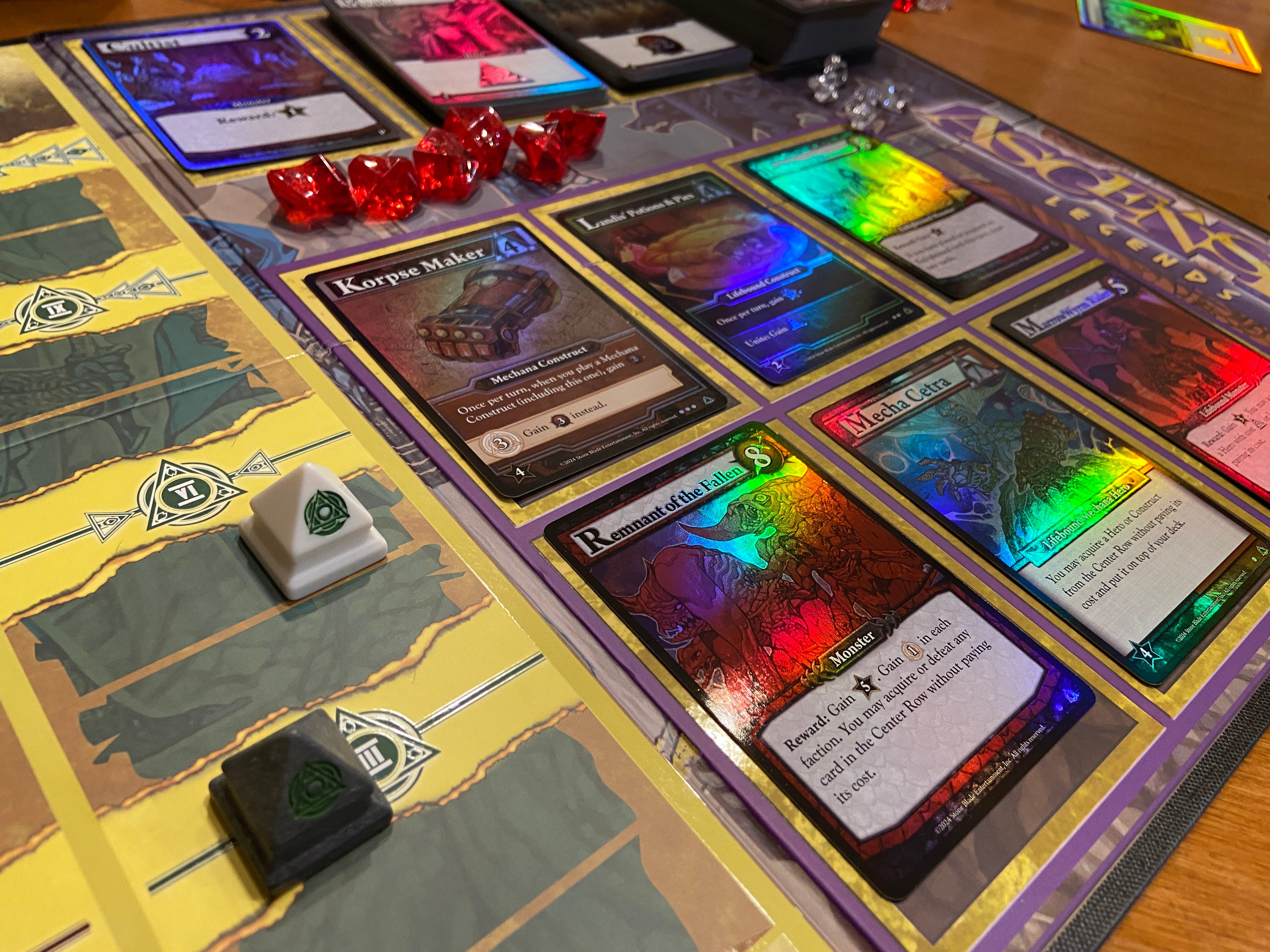
The new Ascension set, Legends, finally arrived in physical form. It’s been available on the (excellent!) iOS/Steam app for a couple months now so I had played it a few times against the AI, but I really don’t play online anymore so I was mostly waiting for the cards. I got the version with foil cards, because obviously. They’re shiny. They’re not that photogenic and probably are less generally usable than the regular cards. I have no idea what the process is for making these things so they’re probably printed using cobalt sourced from the Congo or something. But shiny!
The last couple Ascension sets (Skull & Sails and Curse of the Golden Isle) leaned into the more colorful and thematic with their fantasy-pirate setting. By contrast, Legends is a pretty traditional throwback to the original Chronicle of the Godslayer. There are legendary heroes in each of the four suits that you gain renown with every time you acquire a card of that suit. Every three steps gives you a small power, and cards have their strengths scale up with your renown in their suits. It’s reminiscent of Dawn of Champions (including many dual-suited cards), except that all the legends are in play for everyone all the time — no asymmetrical player powers. Other than that, the factions are very familiar; Void gives you fight and banishes cards, Enlightened draws cards and defeats monsters, Mechana gives you high-point permanent cards with strong power synergies, and Lifebound is all about points and acquiring Heroes (in probably the set’s biggest twist, their typical Unite powers are rare and not a core Lifebound feature). It doesn’t use any of the more recent keywords and doesn’t introduce any new ones.
The only really new thing are the Emissary heroes. Each faction has one, and they give you a draw and add in a faction-related power when they Unite with other Emissaries. These are small effects, but if you manage to play one from each faction on one turn you immediately win. This is the first time Ascension has had a win condition other than “have the most Honor points at the end” I think? I don’t know how I feel about it. It feels like a classic John D Clair “you win” card, something whose presence you feel and is amusing but very rarely pays off. That said, I have seen the auto-win card strategically and successfully played in Mistborn and Space Base. This seems less strategic. If the stars align, go for it. But if you grab the first two Emissaries you see, it’ll be a question just of whether the next two even show up. There are only 2 of each in the roughly 100-card center row deck, of which you’ll usually play about a third. You’ll need enough banishing to thin your deck enough to give you a chance to see them all in one hand in a game that usually goes only 12-15 turns. It all just seems a bit hypothetical.
Nonetheless we really enjoyed it and have already played half-a-dozen times in a week. It’s a great system, and as a 2-player game it’s always satisfying. We enjoyed Skull & Sail and Curse of the Golden Isle, but no question those were a bit outré and didn’t feel as solid as the classic sets like Dreamscape, Gift of the Elements, or Delirium. Legends isn’t as grabby as the flashier sets, the powers are more conservative and traditional, but it still feels unique while also being more consistent.
Drop Zone: Chef du Pont is the second game in this little ASL sub-series of boxed historical modules that cover airborne operations on D-Day. I ultimately soured on Drop Zone: Sainte-Mère-Église; I thought its campaign game was borderline (if not actually) broken and it was overweighted with dumb chrome rules. Did we really need counters for cows? Were they seriously a significant tactical feature of these battlefields? And I did not know what the new 5-3-7 German squads represented or why we needed yet another German squad type (up to at least 10 and counting!). Come on, people. Ken Dunn has done good work on the ASLSK line, and I did enjoy the flavor of the bocage and the paratroops fighting an almost irregular conflict. There were some very cool and evocative bits. But the package as a whole felt undercooked, and for me that’s death in the ASL line these days. It’s also getting a lot more common in MMP’s products, and that’s a real problem. Like, a “huh, I’m really not sure how to deal with this” problem.
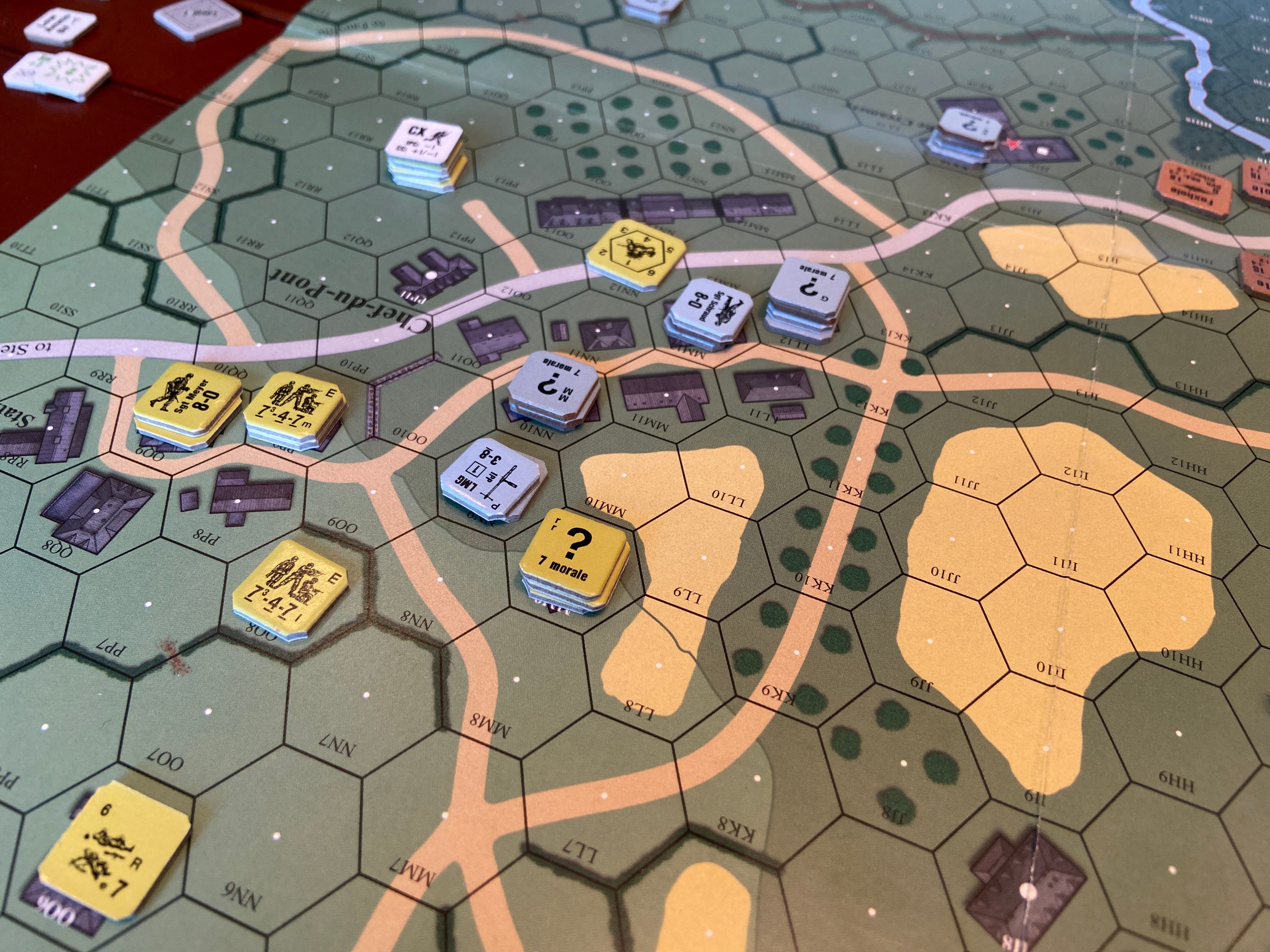
Chef du Pont is, so far, giving off very similar vibes to Sainte-Mère-Église. The scenario we played was basically in two halves, the paras driving to the bridge in the east and the Germans trying to take a hill in the west. They are so far apart that the interaction is minimal; on turn one both sides will make a decision about how to value the two victory conditions (holding the hill vs crossing/defending the bridge) and those decisions will play out over four turns of marching across the board. Half of this scenario — the fight for Chef du Pont itself — is interesting. The other half — the fight for the hill, or the decision to bypass it in favor of racing for the bridge — isn’t. I enjoyed the flavor and the tactics of the village fight, with a nontrivial asterisk. The overall scenario though? It didn’t feel solid.
So the asterisk. You can see what the map looks like on BGG, and it has a similar feel to the core board 12. These sparse villages with a lot of open ground can often lead to players staring at the board and wondering which lines of sight are open and which are blocked. Whole scenarios can turn on whether there is a sliver of an obstacle on both sides of an LOS string as you try to maneuver through the copious open ground and hope. Sure, you’ve got smoke (SMOKE!), but smoke is very dicey and as the Americans you don’t have a whole turn to waste if it doesn’t show up. I don’t know. Sure, the occasional tough call on lines of sight is a reasonable part of the game. But constantly? With attackers dodging from blind zone to blind zone with the preternatural skills of an operative in a spy thriller? For me, it’s not the most compelling ASL imaginable. It made me long for Up Front’s much more abstract line of sight rules. Is that maneuver going to be in line of sight of the enemy? Will you get shot? Nobody knows. You’ll just have to try.
It’s obviously too early to specifically judge the entirety of the Chef du Pont module. I do love the maps, the bocage is surprisingly great and evocative, and there is a reason that paratroopers fighting in Normandy was the second module in the system back in 1986 — the typical small unit actions here showcase a ton of stuff the system is really good at. But patterns emerge and at some point you have to take them seriously. MMP’s core ASL line has been having problems since Festing Budapest, and those problems are not getting better. Drop Zone: Sainte-Mère-Église had some significant issues. The first scenario I played from Drop Zone: Chef du Pont shows similar problems. There is a lot of other ASL stuff to play.
Coda
I’m sitting in as something of a ringer with one of my good friend’s community concert bands, and this piece is on the program. It’s been a long time since I played it, and I had forgotten how much fun it is. Several instruments that have prominent roles in the orchestra find themselves in a weird place in concert bands with their large and loud brass sections, even moreso than clarinets — notably oboe, bassoon, and horn. American Overture is the piece that comes out when the horn section is sick to death of playing off-beats and is ready to walk. It or something by John Williams.
Thanks again for reading. If you value independent voices in boardgaming, please consider becoming a paying subscriber; this newsletter would not exist without them. Please like, share, and subscribe, and I’ll see you next week!