
Luthier, Dead Reckoning
Week of June 1st, 2026


Luthier has been sitting in an uncomfortable spot for a while, and as a result I’ve passed on trying it before now. Thematically, it’s clearly aimed right at me with its beautiful Vincent Dutrait illustrations of musical instruments and homage to baroque through romantic-period classical music. On the other hand, it’s a modern prolific-subsystem point-salad optimization game and that kind of unfocused design doesn’t appeal to me. And it’s long, an hour to teach and 3+ to play with 4 players. The thing about a public gaming group though is that you don’t always get what you want. Luthier was one of the options on the table this week, I was genuinely curious about it, there didn’t look like was going to be a better option, and so despite the pretty good evidence it wasn’t going to be my kind of thing I thought it was worth a shot.
We all know the genre here by now: A million ways to score incremental points, multiple intersecting mini-games, tableau-building, worker placement, advance on tracks. Luthier has it all. I always wonder what the foundational game is this genre is, I want to call it the Ark Nova aesthetic but probably Agricola or Castles of Burgundy is more correct. Regardless, Luthier will be extremely familiar mechanically, but it does deviate from the broad patterns in at least one way: the worker placement element is genuinely interesting and goes all the way back to and is a variation of the original breakout worker placement game, Aladdin’s Dragons. There are only a few places to place workers, your workers have different strengths, and you assign them secretly. During resolution, better workers will go first with ties being broken in order of placement. In the most of these sorts of games, the aggregate demand at the table for a given action spot will dominate your decision-making process. That’s still a significant factor in Luthier, but here your own priorities are a much more significant factor since placing early isn’t decisive and turn order alone will usually give you maybe one win. You need to take more into account. For me, that’s a more interesting game, in general. It still overloads small decisions with way too much information — ideally you would fully analyze everyone else’s board state to evaluate where they need to place workers before placing any of your own, and that’s not great. Fortunately, people don’t usually play that way.
Otherwise, you know the drill. You need to gather resources, use those resources to build and repair instruments, play a simple dice game to do performances, improve the capabilities of your workshop by expanding your tableau in various ways, and balance that all out on a spreadsheet of points. While the presentation is very nice, and some mechanisms are interesting, there is nothing at all novel about the decisions the game asks you to make. The basic decision structure is the same as Ark Nova, Agricola, SETI, Civolution, etc., with a new coat of paint.
For me personally, I didn’t hate the first three turns here (about 1 hour of play). As you’re going out and finding patrons, acquiring resources, and planning how to build your instruments, the game is fine. Very dry and procedural, not particularly deep, and much more random than it appears, but it moves at a decent clip and it’s modestly thematically resonant. It’s not my first choice of game flavor but if it had ended there I would have been fine. Unfortunately it did not. The way the game’s bloat absolutely explodes after that completely lost me. You need to build up a suite of special abilities that will allow you to take big late turns. That’s fine, it’s not the way highly skilled craftspeople like luthiers work but it’s an aesthetic people like. Capitalism, baby! However, it implies games with certain proportions. Luthier is an absolutely standard game of this type in that it has decks of cards that you’re drafting from, and maybe you manage to get those special powers and advance on the right tracks in the critical early phases of the game, or maybe you don’t. If you have long experience with this sort of game you’ll see the patterns and understand the structure, but if you don’t it’s almost totally opaque. Having an engine-building game play out over 3 hours just doesn’t make any sense to me. These are inherently accelerating games. Having them also be really long just creates a lot more opportunities for them to be painfully un-fun, especially when they include substantial luck elements (as Luthier does). People hate Race for the Galaxy solely because it punishes skill differentials and that game only goes 20 minutes or so.
If Luthier is a bit of an unfocussed mess mechanically, it’s even worse thematically. Luthier is a word that means something — it’s a craftsperson who builds and repairs string instruments. I did neither of those things in the game. I only built wind instruments (including a serpent, entertainingly) — not out of bias, but just because that’s what the card flow gave me. I gave performances. I bought and sold resources. Never did I build a or repair a stringed instrument. That’s a pedantic objection of course, but if you’re going to include wind instruments in your game, the only two instrument makers the general public is generally aware of — assuming they know any at all — are probably Antonio Stradivari and Adolphe Sax. But Sax isn’t in the game despite the preponderance of wind instruments, and nor are any of his prolific creations (so, no bass clarinet). Maybe we get the family of Johann Denner, a famous wind instrument working family generally attributed with the invention of the clarinet? Nope. Clarinets are in the game (although none came out in our play), and the illustration is an authentic 5-key Mozart-era instrument, so that’s nice (although it did make me wonder if there might be some filtering going on with the instrument illustrations at least), but none of the related instruments like a chalumeau or recorder that a baroque wind instrument maker would have made (despite the presence of many baroque string instruments). Ultimately it’s all just a very strange grab bag of classical and classical-adjacent “stuff”. When thinking how to describe it, I actually am drawn to Twilight Struggle as a comparison: it includes things that seems designed to let you say “hey, I know that!” rather than to actually serve a coherent thematic structure. It’s a bunch of cultural touchstones. My general feeling is that what makes themes work is specificity. Molly House is doing something very specific. Luthier is not. If you spend a bit of time researching just Stradivari or Sax you find so much material in there that it’s hard to imagine not making a game about these ideas specifically. Luthier instead feels, to me, like a spreadsheet game with inputs to that spreadsheet tagged with historical instruments or people.
The instructive comparison, for me, is with Philharmonix. They’re both trying to grab the classical-music-fan audience even though Philharmonix is a generic space opera setting. Philharmonix though has a legible core activity — putting on performances — that the game revolves around and which makes thematic sense despite the generic setting. While Philharmonix does have some engine-building elements, they’re a far less prominent aspect of the game. You can teach the game in 20 minutes by explaining both the thematic and mechanical core activities, and then play it in 1.5-2 hours, which makes a lot more sense to me than doubling those numbers.
Ultimately what happened with Luthier was that the nice art and everything made a bog-standard spreadsheet optimization game something that I could get through for a sitting. To be honest, that is not nothing! But it’s something pretty specific to me. I kind of imagine I felt about it the same way many bird lovers felt about Wingspan; they enjoyed the terrific watercolor illustrations without getting too worried about the game. I don’t want to discount the importance of that sort of thing from time to time, but if you’re here you’re probably like me and interested in how Luthier functions in the realm of decision-making-as-art. It doesn’t.
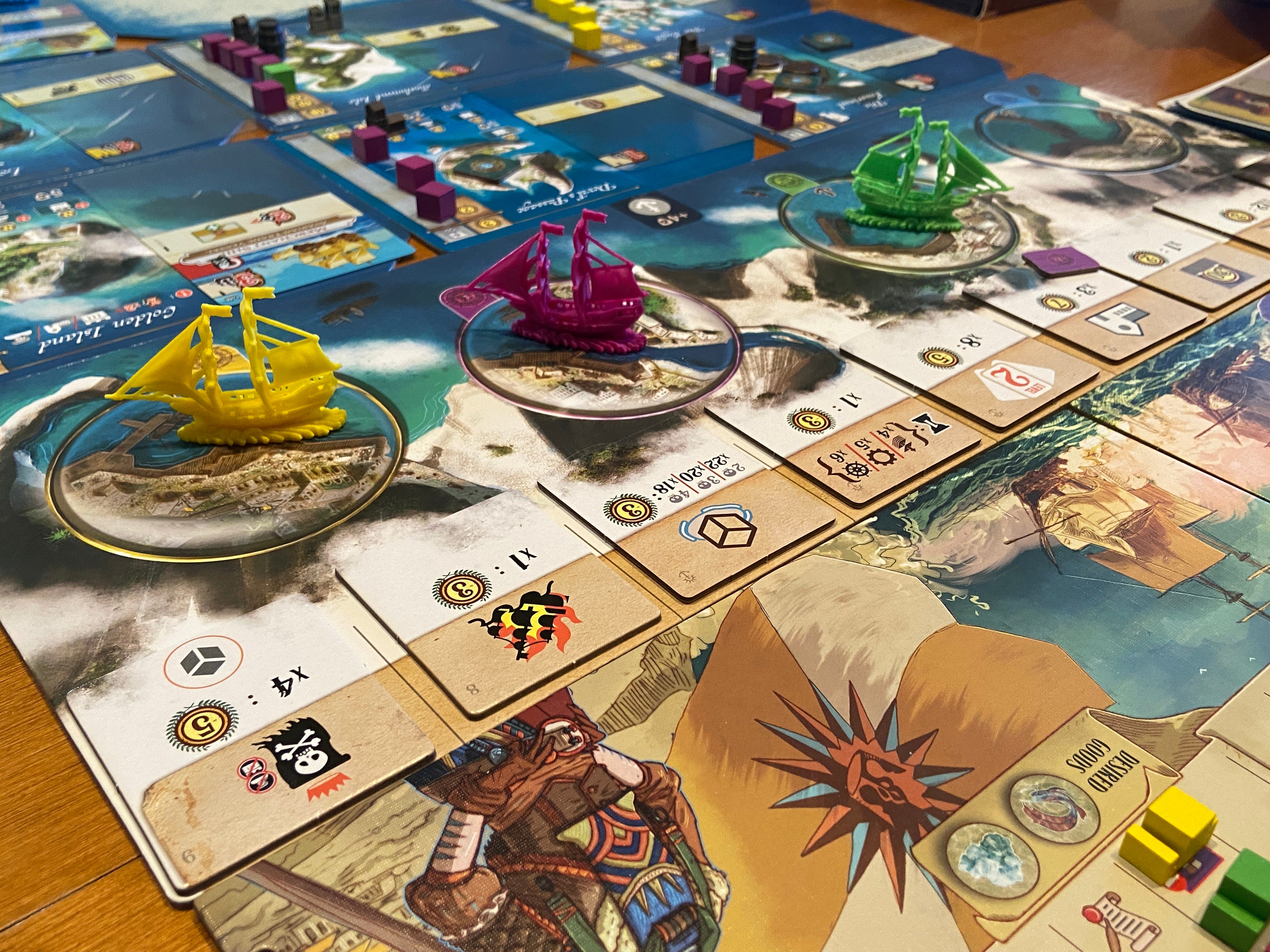
I’m on record as being a huge fan of Dead Reckoning, and my set now includes everything: the base game, Sea Dogs, Deep Legends, Salt & Thunder, Letters of Marque and Port of Call. What I’m reckoning with now is how to move it from a place where I play semi-frequently and so including all the options make sense, to a more infrequent thing where the tolerance for complexity is a lower. It’s tricky because while John D Clair has mostly done a very good job of expanding through parameterization (new cards and configurations of existing rules) rather than adding new rules, by the time you’ve got everything in there it’s all unquestionably a lot and can be daunting for players who are re-familiarizing themselves with the game from a low baseline — never mind if you have to teach. So I’m looking for a new ideal configuration. I think it’s not complicated, it’s just Letters of Marque that is too much. I think you can include the permanent advancements from the first two Saga expansions without issues, and the new crew and ships and goals from Port of Call are great additions to the system that add very few new rules but change the game up a lot. The special cargo and external empires from Letters of Marque though, that’s where things get to be too much for casual, occasional play. We did use everything this time, but next time I’ll probably back off from that expansion. Which is a bit of shame, Letters of Marque has a Saga narrative element I’d like to play, but I probably have to accept that’s not going to happen.
I was reminded though of how good an expansion Port of Call is. The new crew are great and create a more balanced experience since individual crew tend to have a mix of abilities and now key abilities (Buccaneer, Bosun) have been broken up onto multiple cards while crew that were historically considered weaker or more specialized (Purser, Deck Hand) have had their abilities diversified. The new ships aren’t as high-impact, but I definitely see people fall into a rut in how they approach the game (always going hard for influence and island control for example, which is definitely a strong strategy) and the different ships push you strongly in different directions which can give the game more variety. The same for the new achievements. We saw a crazy game unlike anything I had seen before: with the achievement for exploration removed, and a lucrative achievement for colonies available but nothing for buildings generally, we saw a game where the last row wasn’t explored at all until the last couple turns and players ended up making big investments in islands. Almost all the islands got heavily built up, and control changed frequently early on until defenses were built and control locked in. There was actually no inter-player combat; often there isn’t a ton but none is quite unusual. If you stepped back and asked me “is this the game you want Dead Reckoning to be?” my answer would probably be no, but alternately “are you glad this is in the universe of possibility for the game?”, then definitely yes.
Coda
Amy Beach’s Gaelic Symphony (3rd movement linked above) was premiered in 1896 by the Boston Symphony and was the first symphony composed and published by an American woman. As with a number of women composers in this timeframe, she enjoyed considerable success during her lifetime but then the academy kind of forgot about her and her work languished for over a century. This symphony is finally coming back into occasional performance. Her music is really interesting! There is little doubt in my mind that if she had been a male composer her music would have stayed in circulation.
Anyway, I’m linking to the third movement for the reason that will become pretty obvious quickly: it features the bass clarinet quite prominently. By the time you read this I’ll most likely have just finished performing it with the Livermore-Amador Symphony. What’s striking to me is that it really uses the instrument. Most composers use the bass clarinet just for its low range. Beach though uses about two and a half octaves and includes a lot of upper register work, which you almost never hear in orchestra even though it’s a very distinct timbre. I do have a bone to pick though. I’m tacet for three of the four movements (the piccolo has it worse; they only play the short 2nd movement). I would wish that if composers are going to use the bass clarinet, they would actually write parts for all the whole work. Surely there must have been something, even if it’s just in the big tutti passages and supporting the other two clarinets. Otherwise asking a musician to show up for a 40 minute piece and sit there for thirty minutes trying not to look bored and then play one movement seems kind of silly. You’re writing for professionals, if you include a bass clarinet you’re asking the orchestra to pay that person to show up. It’s not like they’re paid by the note. Just go ahead and use them.
Anyway, the whole symphony is worth listening to — it’s clearly using the same language as Dvořák did in his 9th Symphony. I assumed that Beach was building on Dvořák’s work, there are a number of similarities between the symphonies to my ear at least, and that does seem to have been the case. The two works are so close together in time (Dvořák moved to America in 1892, wrote and premiered his 9th Symphony in 1893, and then Beach wrote the Gaelic symphony in 1894 with it premiering in 1896), and Beach cited Dvořák as an influence. But Dvořák wouldn’t use the bass clarinet much until he featured it in The Wild Dove in 1896.
That's all for this week! Thanks for reading, and see you next time!