
New Frontiers, Total Domination, Up Front, and a Euro Roundup
Week of June 2nd, 2025

First, a couple very short status updates. I am on Bluesky now. Say hi if you would like! If you want to get in touch it’s probably the best way for now.
Also, while I intend to keep all the newsletter content free, I’m planning to turn on paid this week to allow you to choose to support my work if you find it valuable, and if you can. Details next week, hopefully.
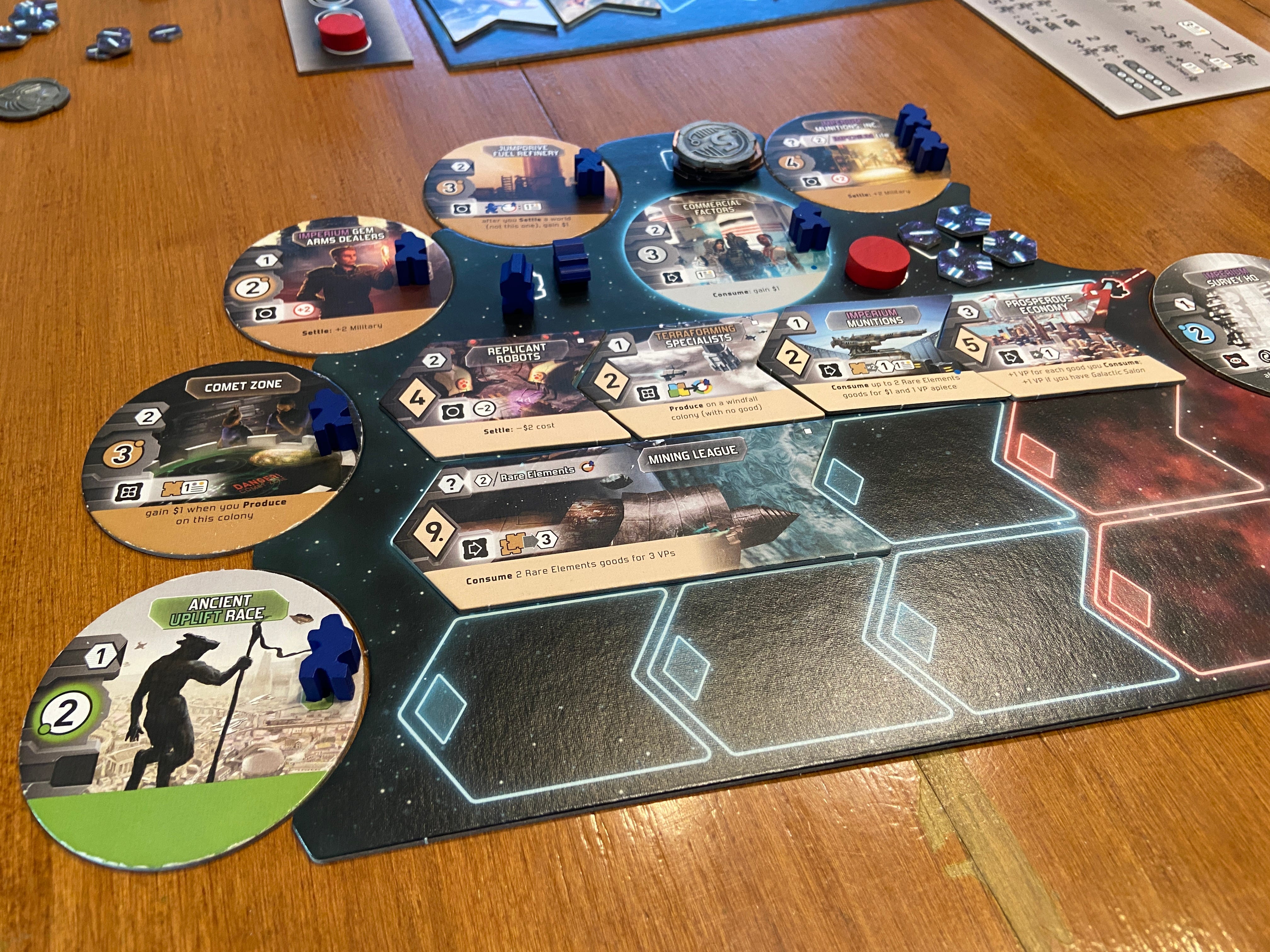
My winning tableau in New Frontiers, with the Starry Rift expansion. We don’t play this that often unfortunately, but it’s such a nice game. More than all the fun of Puerto Rico, but in a slicker package with more variability (and more engagement) plus none of the deeply problematic history. I find Race for the Galaxy’s produce/consume model, where you need to build out both your production (worlds) and goods consumption (consume sinks on developments and worlds), a lot more interesting than Puerto Rico’s tactically finicky Captain. Puerto Rico’s produce/ship is nominally more competitive between the players, but I find it more unnecessarily high-stakes and ticky-tacky than interesting. Drafting worlds with special powers somewhat randomly also gives New Frontiers less predictability (in a good way) and a lot more range. All this is very good, but the really big deal, the thing that takes the game over the top for me, is the tight pacing and playing time of only an hour-ish or so — without feeling as unforgiving as Puerto Rico or Res Arcana. In both of those games it’s usually pretty clear who’s going to win, or the couple people who have a shot, by the halfway mark at latest. New Frontiers feels more open longer and the goals add just enough unpredictability that the game can be in doubt all the way to the end.
Strategically, I do think the scoring from consuming goods is hard to ignore. You can definitely win with a military-only strategy, especially if Improved Logistics is in play, but it can be reliant on finding playable worlds using Explore and usually there isn’t an organic way to get up to the +7 or +8 military you need. You’re going to need some assistance from the bag. If you’re playing just the base game, the best consume engine available is for blue goods using Consumer Markets. One of a bunch of nice things about the Starry Rift expansion is that it’s added a few new and more diverse consume engines, including the Imperium Munitions (brown) which was the centerpiece of this tableau. Many modern euros, including related games like Res Arcana, are broadly speaking about choosing one thing and doing the hell out of it. New Frontiers is much more like multiplayer Race for the Galaxy, in that while you need to have a thing you’re doing, you also have to be flexible enough to take advantage of roles other people are taking as often as possible. You can’t ignore the produce and consume roles.
For me, the other fun thing about New Frontiers is that I seem, inexplicably, to be extremely good at it. I was horrible at Puerto Rico for some reason, and I’m only a decent Race for the Galaxy player. Somehow New Frontiers is really in my sweet spot and I’m not totally sure why my friends, who are much better than me at more intricate games than this, have trouble keeping up.
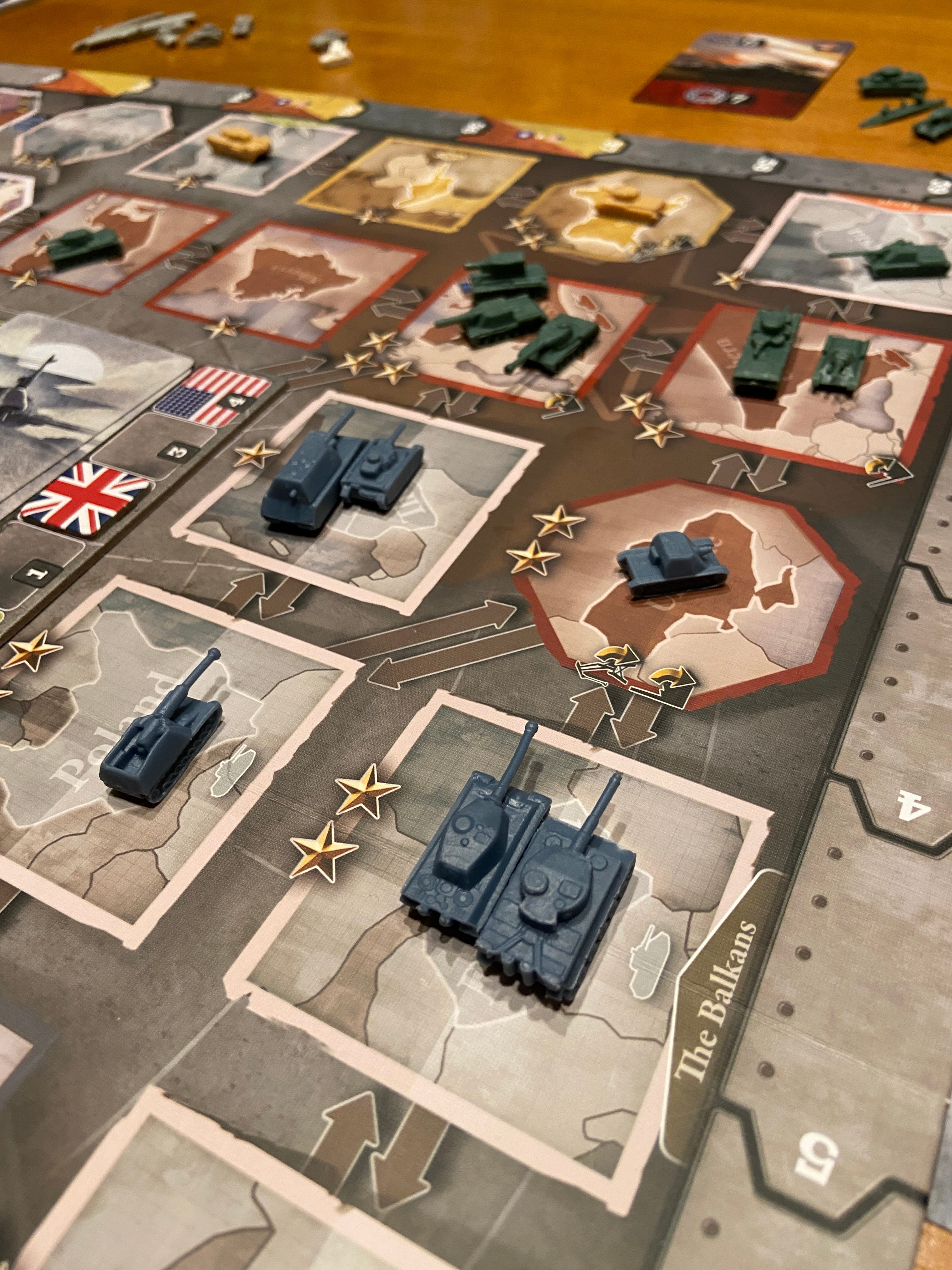
I had somewhat reluctantly added my copy of Total Domination to my table at the latest local flea market, even though I like the game quite a bit. It just had never found its constituency and hadn’t left the shelf in a while. It attracted no interest, so it came back home and went back on the shelf and I told myself I need to try to play it again. I managed to find an opening, and I’m really glad I did! It’s a quirky, unusual game. I do wish the rules were written better — despite thinking I was familiar with the game I managed to screw up an important rule for the first turn because the reference sheet was confusing. But underneath that it’s surprisingly elegant and generates a ton of interesting and difficult choices as well as a great narrative arc.
Its closest analog is obviously the Quartermaster General series of games. Total Domination is a team game with the same “your turn is playing one card” structure, and it’s very much about tempo and how the two players on a team decide to coordinate their efforts against their opponents when they have the initiative. In Total Domination, each card gives you a choice of between 3 and 6 action points, research, or a simple event, so tempo management has a little more nuance than QMG, and since the game is played in hands of 3-5 cards there is also more of a planning element in managing bad hands and taking advantage of good ones and judging when to make your lunge for the victory.
QMG is a game system that I have played heavily and gotten a lot of enjoyment out of for over the last decade-plus. It also seems to be running out of gas, with the exception of the excellent Cold War and the recent 2-player East Front (and War of the Ring: The Card Game, although that’s a bit of a different thing). With all of the others (WWII, WWI, Victory or Death) we’ve had games recently where things went a bit off the rails, or one or more players actively didn’t enjoy it, and there has been a general sense that the system has hit the end of the line for us. It’s not totally clear to me why this is, but I think the team dynamics are too treacherous. Many of the decks are not straightforward to play, and with experience levels all over the place these days it’s easy for team members to feel frustrated or put-upon or like they’re letting the side down in ways that are not fun. Back when the games were new and everyone was exploring them roughly together it was easier.
For now, Total Domination seems to fill that QMG niche in a less fraught way. Everyone just gets cards from a common deck, and while there are events coded to individual countries they’re straightforward so you don’t have to master the intricacies of a highly personalized deck. The asymmetry is generated largely through a clever and very simple but high-impact research system, which allows the players to explore different strategic paths. The game is just not as sensitive to very specific mastery skills.
It’s also very, very abstract. It’s more of a WWII flavor than an attempt to evoke any specifics about the conflict. It has an overarching sense of narrative, with the Axis having the initiative early and then the Allies have to claw it back. But as the very interesting and highly abstract map telegraphs, this is a game about vibes, not details. But in many ways, that’s actually good. In, for example, Quartermaster General: Victory or Death, people who have a solid knowledge of the history will have a surprisingly large advantage over those who don’t. This is just not the case here; it’s ultimately a mechanics-first euro, albeit one which does do some interesting work with its setting.
I played this a bit in its original Mini WWII version from Formosa Force Games, and initially the Phalanx production seems like a hilariously overproduced European version of a nice, compact Taiwanese mini-game. And that’s not exactly untrue! I mean the miniatures pack comes with sculpts for like 20 different tanks, some quite obscure. I needed to break out my vehicle notes for ASL to figure out what was going on with a couple of these. However, I’ve come to appreciate it. The system has been significantly improved; I like the new card draft at the start of the turn a lot, and the new optional rules (subs, air forces) are simple but evocative and impactful. It includes the odd but fun Arctic expansion. While the new, more naturalistic map and pieces aren’t a clear win one way or the other, the cards that you spend most of the game looking at are really well-done, clear and colorful with very nice and evocative art. Phalanx has struggled with significant usability problems in its games for basically its entire existence, so it’s been great that the couple games I’ve been playing from them recently (this and Purple Haze) have had no major issues in that regard. I did go back and read the Mini WWII rules, and their structure and language are vastly superior and a model of brevity and clarity (minus a couple obvious translation challenges) compared to the sprawl that is the Phalanx rulebook, and that’s unfortunate. Phalanx has gotten a lot better at quite a few things over the years, but their rules remain a problem and that’s not great.
So anyway, I continue to like this a lot. Good team games aren’t common, and Total Domination does a good job with this flavor. It doesn’t engage deeply with the history, but it does treat it with some respect. It’s fast-paced and dramatic. And as a Taiwanese game it has a flavor that is distinct from traditional euros.
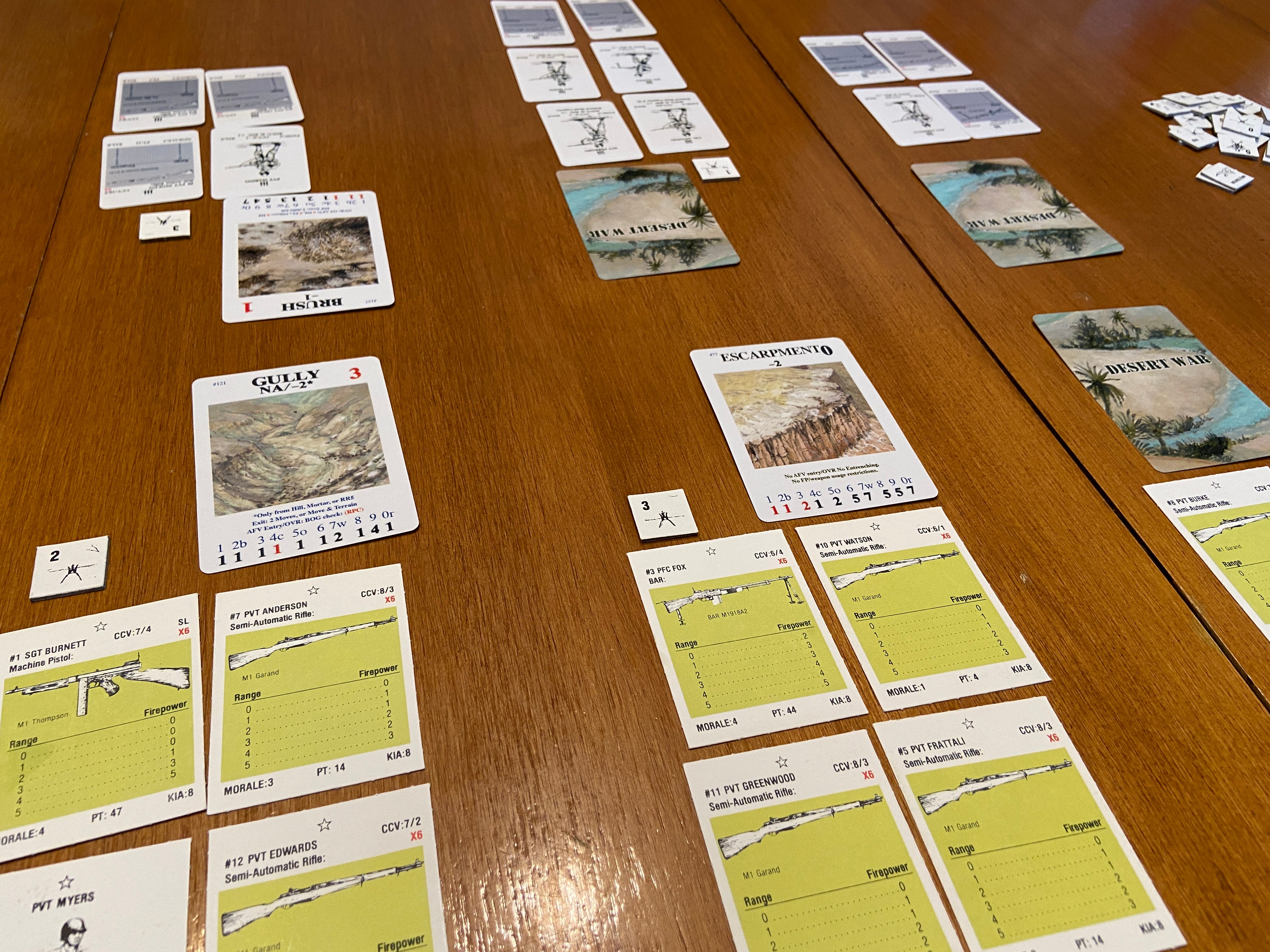
The Desert War expansion for Up Front was notoriously problematic (it was not designed by Courtney Allen, but by a couple guys with limited or no other credits). The main thing it gave us, personality cards and rules for the Italians and French, was punitive to the point of borderline unplayability. The desert terrain rules were difficult to use in practice because you had to keep a bunch of terrain substitutions in your head (buildings are really escarpments with different rules, rivers are wadi, etc). Even though I played Up Front a ton in the 80s I think I had never played these rules before, just because without replacement cards for the action deck it was too awkward. I sold my copy of Desert War years ago for a surprisingly large amount of money, but WargameVault has come to the rescue by giving us a new edition that includes a custom deck of Desert cards and a reissue of the French and Italians at reasonable cost.
I was pleasantly surprised by the desert rules. The art on the new deck is nice, and the new terrain has an evocative feel. It’s not as open as you might think, there is still a decent amount of protective terrain between the escarpments, ridges, and wadi. But there is definitely less, and moving is more treacherous. The new minefield and oasis rules are colorful, even if the oasis is a bit goofy. Overall it’s definitely got a different flavor and is quite playable, so a fun and legit addition to the system. WargameVault’s custom Jungle and Desert decks are a major deal in terms of making those different theaters easier and much more fun to play.
What to say about the Italians? The design in Desert War is straight-up bad. The Italians are portrayed as totally incompetent, with their 18-soldier, 2-LMG squad hopelessly outclassed by the US and UK and destined to lose almost any scenario. The Italian army in WWII had a ton of problems and was probably the worst-performing major power army in the conflict, but even in that context the rules for the Italians seem wildly punitive. It’s been a long-term, slow-burn project for me to rehabilitate both nationalities from this pack into a playable form; having two more reasonable nationalities would expand the game’s range a lot. Here’s where I’ve currently landed for the Italians: Soviet hand (4 cards, unlimited discards if no actions), US split action cards (exception: treat Smoke as cower cards), use the surrender rules (50.41) but allow use if a Hero to rally a soldier and remove the surrender marker.
Short Takes
Fishing: I finally got my hands on this when the 2nd printing came in recently, and it’s hit the table a few times. I’ve quite enjoyed it; the fusion of deck-builder with trick-taker with Fable-style game is crazy, but it’s very easy to explain and the ratcheting power level of the Fable engine makes it more dynamic and engaging than most games in this space. My gold standard for this broad category of games is Custom Heroes (soon to be back in print as Ruins), but Fishing is nice and while ultimately disposable it’ll get a bunch of play before then.
Mystic Vale came out again recently after a long hiatus. We played with 4, which I don’t think is the game’s sweet spot, but nevertheless it reminded me that this is a really solid, enjoyable game. I do think the expansions got better as time went on though. The core game and first expansion were fine, but control and speed could almost always dominate and you had to grab those cards whenever you could. The later expansions have enabled a wider variety of play which improves the game a lot. Whenever I build play sets I always include a couple conclaves from Nemesis, Harmony, and/or Twilight Garden. I enjoyed our play enough that I spent an hour or so organizing the whole collection, tearing down the play sets we had which were ok but not setting my world alight, and building up a couple new ones which I am excited to try.
Molly House is still getting play. I was a little worried that since the game was so unusual and with such an interesting core idea, maybe too much of my enjoyment of it was in figuring out how it worked and how it engaged the players and what it was saying. So I’ve been glad that it’s continuing to hold up well just as a game.
Unstoppable also continues to come out occasionally, mostly solo but occasionally two-player. I think I actually like it best as a solo game, which makes it the first ever solo euro-type game I’ve been enthused about.
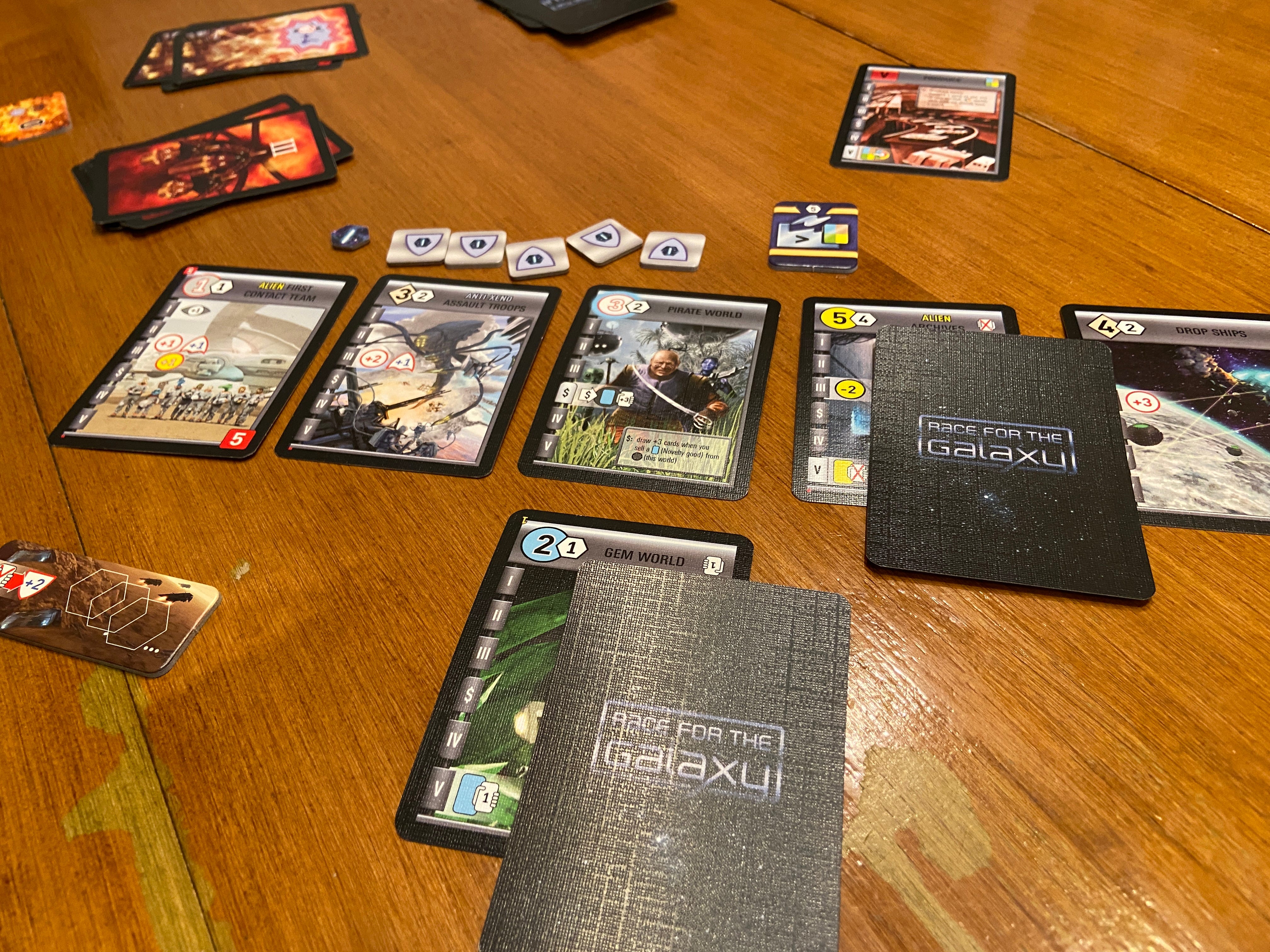
This was crazy, but I’ve actually been playing a bit of face-to-face Race for the Galaxy using both the core set plus Gathering Storm, and Xeno Invasion. I play the game a good amount online, especially 2-player, but for me the best experience is still 4-player in-person. It’s such a good game! Fast, tight, and while it is rough if you have players of very different experience levels, it’s more forgiving and dynamic (and faster!) than Res Arcana. The nice thing is, if you just play Xeno Invasion or Alien Artifacts, the problem of varying skill levels seems a lot less severe. I must have played the original arc of the game hundreds, if not maybe a thousand times. I know that card deck like the back of my hand. Xeno Invasion and Alien Artifacts I have played at most a couple dozen times and there are still cards in there that surprise me. So for me anyway it’s a bit like going back to the early days of the game, when nobody had any kind of significant experience edge and there was still the joy of discovery. Plus, I enjoy the physical game much more than clicking around on cards.
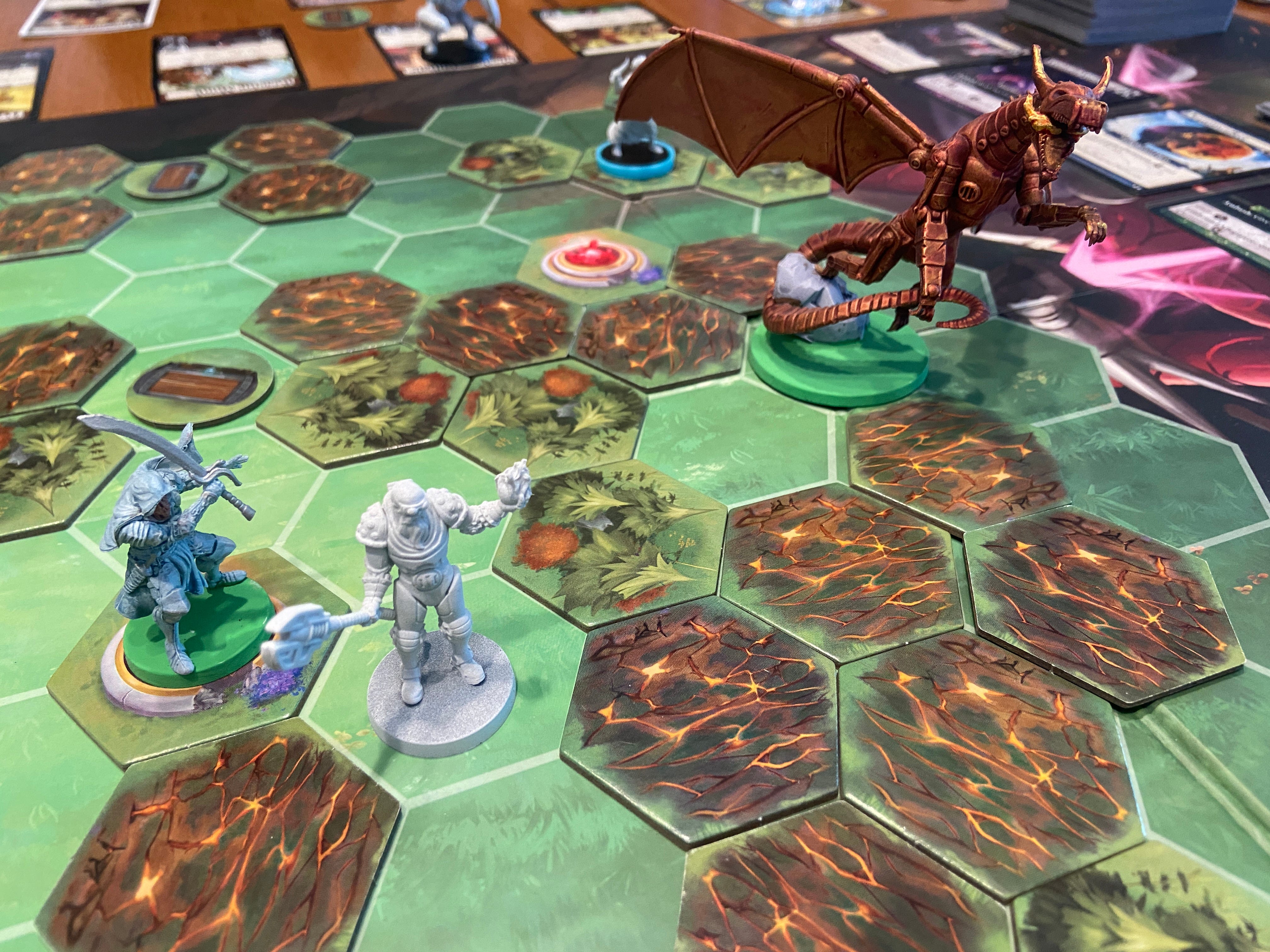
We went back and played some of the original Ascension Tactics after enjoying Inferno so much. It’s funny, it feels positively staid and methodical next to the crazy-bonkers Inferno. The two sets are really different! I thought it might be tough to go back after seeing the way the system’s horizons had been broadened by Inferno, but it was not. I really enjoyed the contrast of the sparer feel. We’ve embarked on the project of painting the figures, which has been fun and has of course markedly enhanced the appeal of the game. With the speed-painting techniques now available, I’m sorry I didn’t do this a couple years ago!
Coda
This wonderful piece, which I discovered over the pandemic, is not just one I enjoy listening to but is also now on my music stand. I hope to perform it later this year. The last movement particularly (“Gone is Gone”) is worth listening to.
That’s all! See you next week!
What are the speed-painting techniques you refer to near the end of the post?