
Sidreal Confluence: Bifurcation, Arcs, Root, ASL in the Philippines
Week of January 12th, 2026

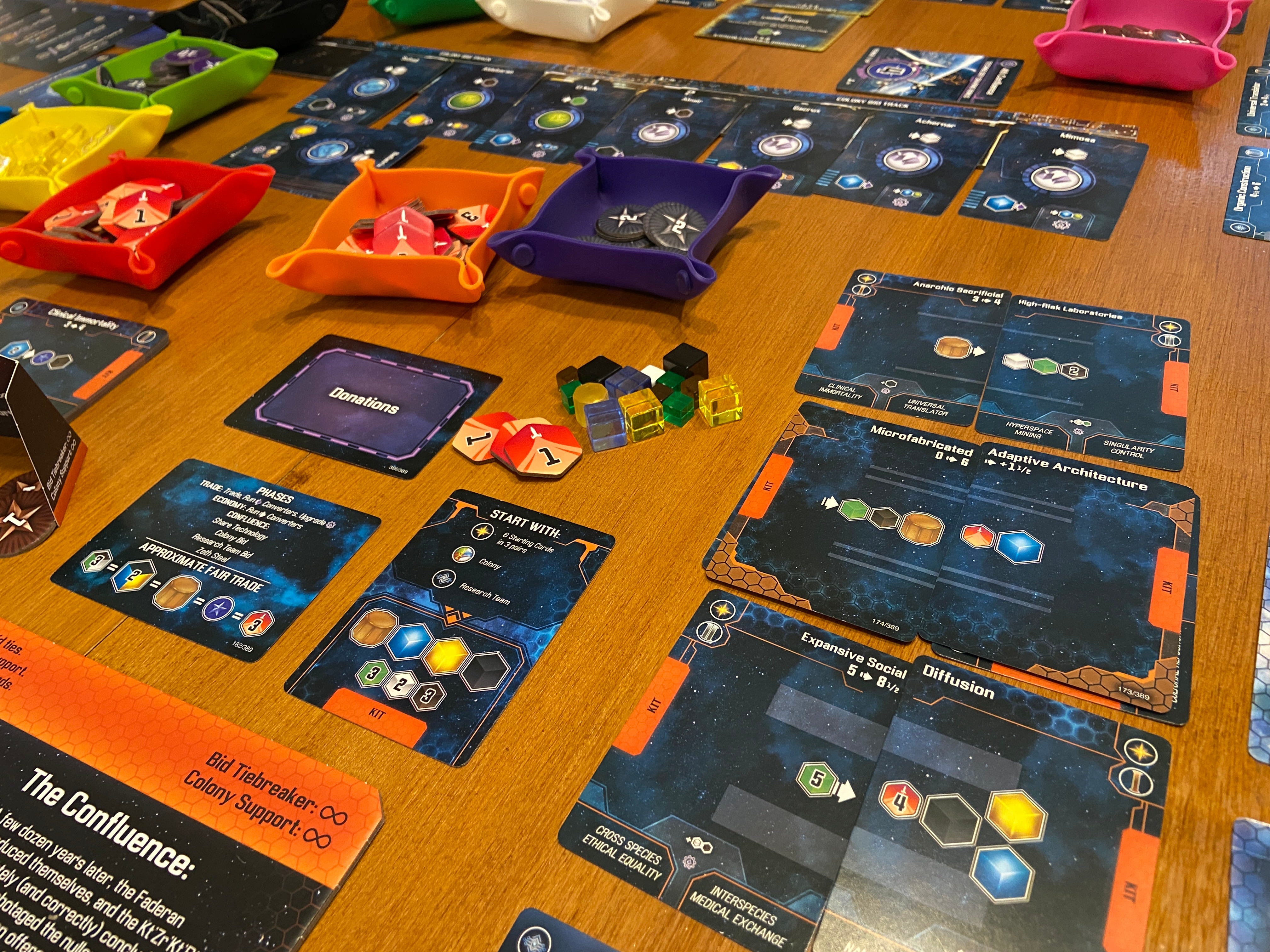
I’ve had a chance to play Sidreal Conflunce a couple times in the last month or so, which I’ve thoroughly enjoyed. There have been a few things that I’ve figured out.
I played my first “full” 9-player game. I had not intended to try to play with 9 (I usually like 6-ish) but a game I was trying to arrange at the Guildhouse seemed to cascade at the last minute and we had tons of players. I think we ultimately had to turn someone away, so that was crazy. Since Sidreal Confluence is a trading game with essentially no downtime, I always assumed more was better and I wasn’t wrong. The economy with 9 players felt more complete, it felt like you always had some kind of trading options and you weren’t stuck because what you needed just wasn’t out there. The level I technology comes online quickly so your economy is likely to upgrade faster and not get stuck because crucial technology is delayed. That’s all nice. But this is also a game with a sprawling footprint and the physical space presents challenges. We had a long table that could seat 9 comfortably (4 on each side and one at the end) and had enough space for the large card tableaux. But it was not easy for the people on the ends to interact with everyone. Ultimately we would end up scooping up our cubes and walking to the other end to see if a deal could be done. This is fine in principle but had two problems. One was just maneuverability; space was pretty tight so it wasn’t always easy to get out. The other is that Sidereal Confluence rewards situational awareness and you just can’t be aware of what’s going on at the other end of the table. It’s typical that you’ll be towards the end of the trade phase and have a grab bag of resources left over that you can’t use and can’t figure out how to turn into something you can, but notice that your neighbor has an idle converter that you can run. So you can make a deal to split the proceeds. It’s a small thing, but in Sidereal winning is often the accumulation of a lot of small things. I wasn’t surprised that ultimately the winner was a player from the middle of the table just because of accessibility. Ultimately, for me, 9-player Sidreal Confluence was a great experience and the bits of friction were worth it. But I wouldn’t try to do this regularly or think of it as aspirational. In general I’ll still think of it as a game that’s good for 6.
I now have a decent amount of experience with the factions from the Bifurcation expansion. They are generally billed as factions for people with a good deal of experience with the game, and I think that’s broadly true, but I also think you can throw in a few of them right away and they can fill a niche the core game is missing.
Deep Unity is a fun variant of the Unity that isn’t hard, technically, to play and their optimizations are more straightforward in my opinion than the core faction. The core faction is hard, it seems to me, because it is tied to maximizing small returns on dozens of individual transactions. They don’t really have a power move; they just need to persist in extracting small margins. Deep Unity does in fact have a power move; they have random converters each turn so if through dice manipulation they can bring in their powerful doubles and triples they can get big swings. This feels a bit more intuitive to most gamers I think.
The Yengii-Jii are not exactly straightforward, but they’re easier and more intuitive than their core game cousin Yengii. The Yengii are, in my opinion, by far the most difficult-to-play faction in the game and most subject to the whims of fate. They have trivial rules, but the consequences of those rules are complex and vast. You need to able to sell licenses to your technology and in a game as big and sprawling as Sidereal Confluence finding those specific deals (and having customers who know when they need them) is, ah, not straightforward. The Yegjii-Jii restrictions are not a walk in the park either, but they can be more active to play.
The Zeth Charity Syndicate is a complexity monster. But it’s not worse than the core Yengii, and a lot of folks don’t like the core Zeth and their protection racket that much since it seems to break the spirit of the game at least to some degree. There’s always that one guy, it seems. While the Charity Syndicate is a beast, it’s also a bit more thematically consistent with the other factions.
The Eni Et Engineers a little bit more complex rules-wise to play than the Ascendancy, but they are also a bit more intuitive and have “chunkier” deals they can make. Their service tokens are a bit more obviously useful than the interest converters. I think that’s why they ultimately get a lower complexity rating. I think they can be subbed in right away if you want.
Most of the rest of the new factions (Grand Fleet, Falling Light, Technophiles, even the Collaborative) really are complexity beasts and while an experienced player could play them in a game with newbies, they probably want to stay in the box until game 10 or something.
I’m up to about 15 plays on Sidereal Confluence now (5 with at least some elements of Bifurcation). It’s a game that just for logistical reasons is not going to get that much table time, but which I nonetheless adore. At the same time as it’s not actually that complex rules-wise, it’s also over-the-top by euro standards. It’s wild, but also relatively comprehensible. I’m actually not that very at it, but I never find it anything other than totally absorbing. Even when I get stuck with the Yengii and know that I have to hope from the get-go.
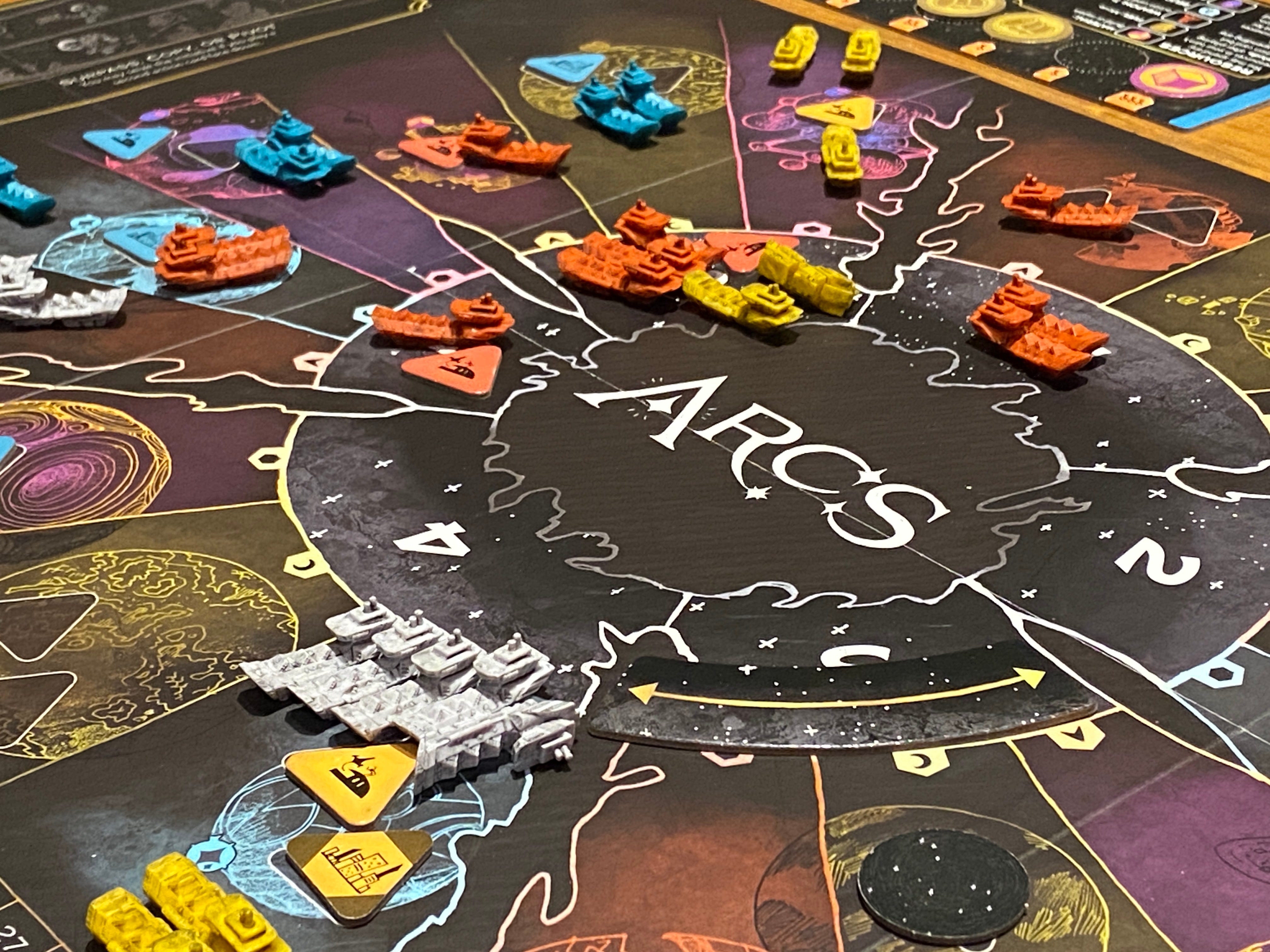
Arcs got some table-time after a break, which was great. I hadn’t played it in quite a while so it was nice to be reminded why it’s so great. As often happens to me I had an extremely strong position through most of the game but collapsed at the end. Like Sidereal Confluence, for as much as I adore the game and have played a lot at this point, I don’t win very much.
We played the Leaders & Lore version which I think is great, but while I think experienced players will prefer it because it’s more flavorful I also am not sure if it’s obviously better than just the vanilla game. Asymmetric player powers are fun, but core Arcs already has strong, naturally-developing asymmetry. Sometimes having strong asymmetric powers can deprive you of strategic flexibility. I tend to think of Arcs as a game that punishes inflexibility, so I feel like you have to be really careful that your special powers don’t box you in.
Our 4-player game went the full 5 chapters (as I think most games will) and took 3 hours. I don’t think that kind of playing time is a problem, I thought it was fine. But it’s definitely not what the box says. I don’t think even very experienced players are ever reliably going to see 2 hours for a 4-player game. Expectations matter. If you come in expecting a 2 hour game and it goes 3, it’s potentially a problem. If you have a new game and you sell it to some friends who don’t really know anything about it as 1 to 2 hours and it ends up running 3, that’s not great. People’s sense of pacing will be wrong, expectations are violated, they end up stuck at game night later than expected, whatever, it’s all potentially varying degrees of bad. I’m a supporter of Cole Wehrle, I think he’s among the most interesting designers working today, but putting 60-120 minutes on the box instead of 30-45 minutes per player was a serious error and it’s hard not to think that this was marketing and they — whether it was Wehrle or Leder — should have known better. They had a big enough buy-in from the Kickstarter.
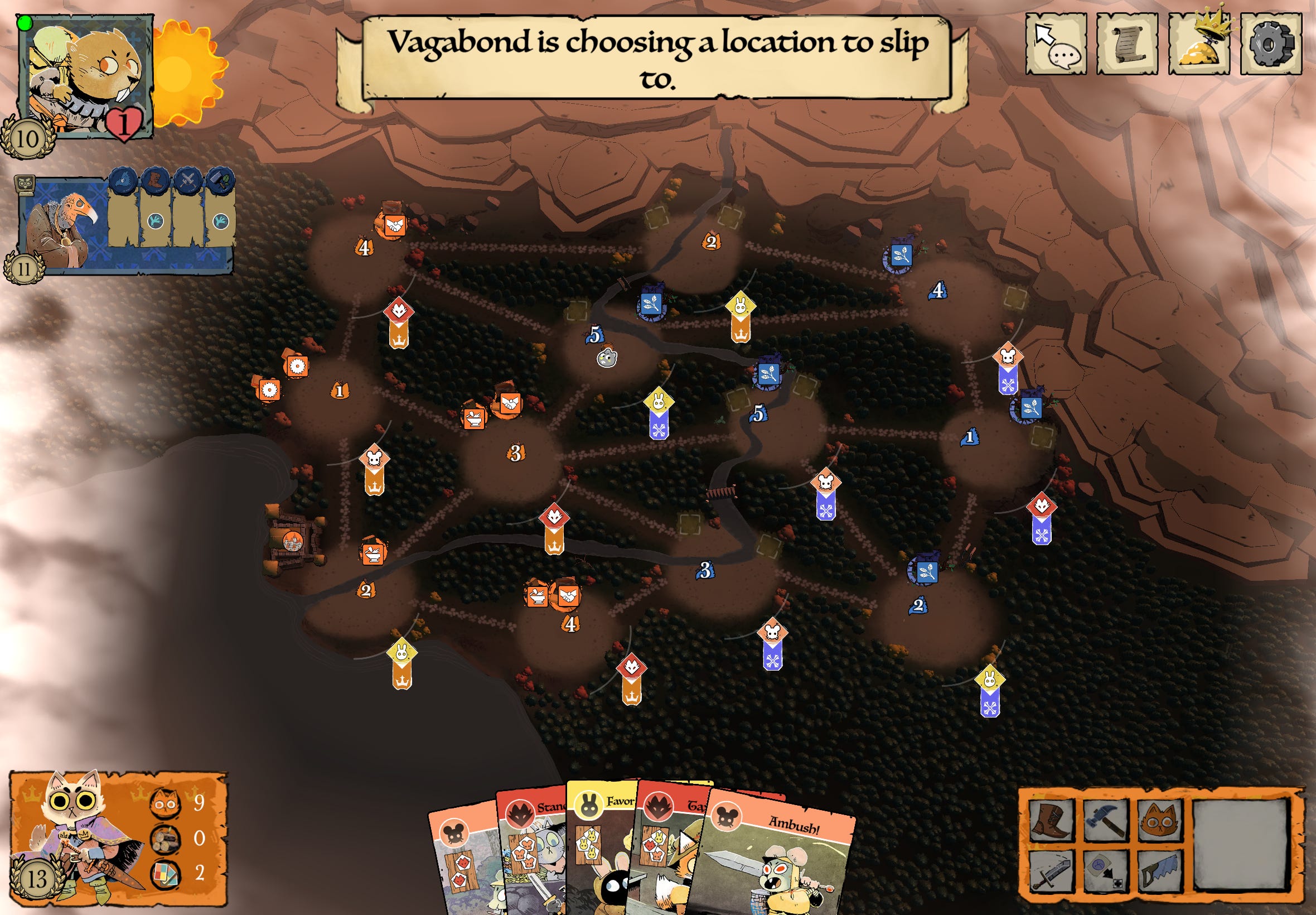
I’ve been revisiting Root for a number of reasons, but for now it’s mostly on the iOS app. Root is a boardgame, so like all ports it losing a little something in the transition to digital. After a number of years though, the Dire Wolf adaptation is now useable. The AIs are still pretty useless — they have no table read in a game that’s all about table read — but it’s good for playing with humans.
The main comment I wanted to make though is that I think Root is a bit underrated as a 2-player game. Root is obviously a multiplayer game at its core. But there are a number of 2-player matchups which work quite well: Marquise, Eyrie, Duchy, Hundreds. It’s a bit more strategic and has a feel of a contest over control instead as opposed to the very opportunistic feel of the multiplayer game. Is it something you’d play instead of purpose-built 2-player conflict euro like Wir Sind das Volk or Lord of the Rings: The Confrontation? Probably no, but it is a unique flavor and it’s a very good proving ground for ideas for the larger games. I’ve ended up being impressed at how well Root works at 2 to 5 players with careful faction selection by an experienced player. I haven’t tried 6 players though. It feels like it would probably be pushing it without a very careful mix (Woodland Alliance, two Vagabonds, Riverfolk, Eyrie, Marquise maybe).
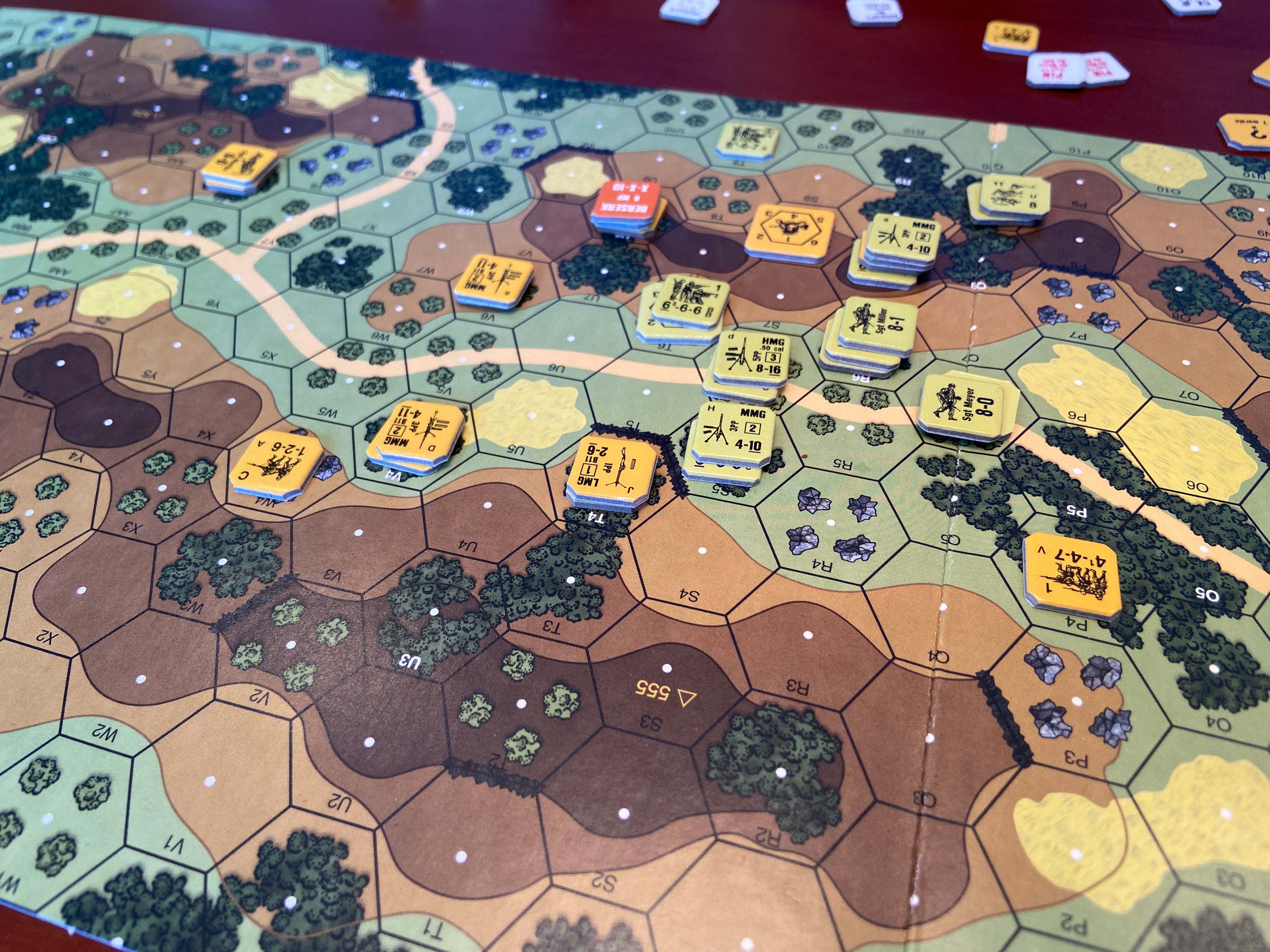
I haven’t talked ASL for a while! I haven’t played a ton over the last month. This is AP223 Gravy for the Gander, from the latest ASLOK action pack. It features a new board with some new woods, orchard, and crags graphics.
The scenario is a potentially interesting situation. The Japanese are doing a fighting withdrawal, trying to pull back to a perimeter on the edge of the board while buying time. They have a small number of reinforcements who enter behind the advancing US. The setup zones for the two sides actually overlap slightly, so the situation is fluid and confused from the outset. This is a natural for me; I love fighting withdrawal scenarios, which give the defenders a difficult but highly active job. As usual though, the Japanese have a lot of trouble standing up to US firepower. This scenario in the Philippines in May of 1945, by which time the Japanese had been pursuing “force preservation” as a strategy for quite a while: keep soldiers alive until they could bleed the Americans from strong defensive positions. ASL never really lets the IJA adapt though — for reasons that are not unreasonable — so their forces just melt when faced by post-1942 US firepower. This is a Pete Shelling scenario and he knows what he’s doing, but this felt very hard on the Japanese facing methodical US play.
I have to say I don’t love the new map style. The new woods art looks great, but the crags and orchards are too similar. It also has crags and orchards scattered all over the place, which turns out is a problem. The ways these two features are depicted makes them completely obscured when units are stacked in their hex. On most boards, where crags are rare and orchards come in larger fields, it’s not a huge deal. Here though it’s really easy to miss orchards or crags that units are standing in because of all the one-offs in random places. On the other hand, the map does have a distinct feel — cluttered but not as dense as the jungle boards — which has not been the norm as we get close in on triple digit maps. That’s nice. I still didn’t love it. At this point, I don’t see any reason to keep making the narrow, 1977-format maps. If you want to make more maps — and because we’re in late-stage capitalism I understand this might have to keep happening even though we already have what, 120+ maps — make them in the more useful wide AP-style format.
Around the Internet
One of the YouTube science channels I enjoy, kurzgesagt, has a new history channel: Nightshift: Kurzgesagt After Dark. It’s possible the German creator didn’t totally grasp how that title sounds in English. Anyway, their debut video about Zheng Yi Sao that mixes politics, social history, and economics made me think this whole thing would be perfect for a Wehrlegig-style historical game. We just got Zheng He from Little Monks, a decent historical euro game covering another of China’s most famous admirals. I hope that as the game makers in Taiwan, South Korea, Hong Kong, and Japan get more ambitious we can get more serious historical games.
And, as this has been a bit of a Cole Wehrle-heavy newsletter, I thought I’d point you towards the news of his and Kyle Ferrin’s split from Leder Games. I can only observe what’s publicly available, I don’t know and have never met any of the principles here, but still I found it pretty unsurprising. I hope Root continues to thrive, and I eagerly look forward to seeing what Buried Giant comes up with. Apparently one of their first things will be an Arcs expansion, which is cool. Looks like it’s not another huge campaign, but a set of pluggable modules? This seems like the right direction to me. I love the Blighted Reach campaign but it’s a lot and it can’t really be played casually. Some new spices for the core game are something I could use more regularly.
Coda
After recommending Danzon #2 last week, this Puerto Rican dance-themed piece by Shelley Hanson popped back into my memory and I’ve been listening to it. I’ve played the suite it’s part of, Islas y Montañas, maybe two or three times in my various community concert bands. It works well for community bands because even though it’s not easy, it’s high-energy enough that if you bring enthusiasm you can sell it to a live audience. Still, if you’re going to listen to a recording, listen to a high-end college or pro wind ensemble. Nice clarinet trio as part of the opening too. The whole suite is only 15 minutes or so and highly recommended.
Thanks for reading, don’t forget to like and share, and see you next week!
Great post this week. Sidereal is an unplayed hall of shame game I nevertheless cannot get rid of but can't get to the table, feels like a unicorn game that's strange it got made and it has an expansion... the mini expansion was also a surprise.