
Unconditional Surrender: Western Campaigns, Spirit Island
Week of February 16th, 2026

Things have been a bit quiet for me on the gaming front for a little while now, for various reasons. But digging into the play archives, I still have a few games to think about. This week’s newsletter will be a little short again, but hopefully things will get back to a more regular rhythm soon. I’m really looking forward to two new releases that should be here imminently: Carl Paradis’ Battle Commander from Sound of Drums, and Compania from Yog Akase and Level 99. And next week I should be able to write about the Robin Laws’ Yellow King RPG. On with this week …
Unconditional Surrender! Western Campaigns is 2014’s Unconditional Surrender!, sliced up into a small scenario format. So the scenarios you’ve got are Poland ‘39, Norway ‘40, France ‘40, Tunisia ‘43, Italy ‘43-‘44, France ‘44 and maybe one or two others that I’m missing. As far as I can tell there is no new content, just a change in packaging and the same truly awful rules. Unconditional Surrender itself is one of the quirkier mini-hits of the last decade or so — you can try it out on BGA! — and I admit it’s one I don’t totally get. I played it back when it was new, including doing the full campaign for 1943-‘44. To my mind, it’s a pretty vanilla strategic WWII game that’s trying to give the various campaigns a more operational and less tactical feel. Units are largely undifferentiated (just amor, infantry, and garrison, with a small number of elites) and the counter density is low (there is no real stacking). The core game loop reminds me pretty strongly of the old Metagaming/Avalon Hill Hitler’s War and its move-one-unit-at-a-time with the potential for big moves and wide, sweeping breakthroughs. I felt Hitler’s War was in a better spot though — even fewer units, a tiny map with only a few hexes between Berlin and Moscow, but much more and more evocative campaign detail. Armies could differ a lot in their mix of infantry, armor, and air and campaigns could be dramatic and exciting and were, crucially, fast. It felt like it hit a better level of abstraction. Despite its grand sweep, Uncomditonal Surrender doesn’t give you a lot of levers to pull operationally, and like the classic Third Reich, tactical air power utterly dominates. The combat system is a single-die-differential with a mostly empty CRT and so big modifier imbalances are required to get results. With units being overwhelmingly identical and with few modifiers available for odds or flanking outside of extreme situations (since you’re activating one unit at a time generally), the only big hammer you can usually bring is air support. Because the combat system is relatively insensitive and when you’re facing a serious opponent it rewards rolling a ton of attacks and hoping to get lucky once or twice rather than really focusing your effort, it’s all a bit fiddly. It reminds me of Cataclysm: the game seems to work best when one side is absolutely hammering the other — when it has access to lots of advantageous modifiers for unit quality and support — and substantially less well when the sides are more evenly matched and modifiers are usually a wash.
I feel like this is reflected in the campaigns in this box, virtually all of which are blow-outs and almost solitaire games while the couple which are well-matched (France ‘44, Italy ‘43) are relatively uninteresting games that hinge on dice. The suggestion for play balance for most of the campaigns is simply to play them twice and see who does better as the dominant side. Because the game is so air-centric and so otherwise low-density, the France ‘40 campaign is just Germany grinding down the French Air Force and then hammering away at the French Army until they win. Once the French Air Force is gone, which is only going to be a question of rolling a load of dice to see if it takes 6 or 8 or 10 sorties — there are basically no modifiers at all for these combats — the French are out of ways to meaningfully influence the campaign other than to roll well.
I’m left unclear what niche Unconditional Surrender is trying to fill. We have a million of these strategic WWII games now (Unconditional Surrender, Downfall, The Supreme Commander, Totaler Krieg/Dai Senso, A World at War, Europe/Asia Engulfed, Absolute Victory, Hitler’s War, Barbarossa to Berlin, World in Flames, even Axis & Allies — and that’s just a sampling — with all of them tracing back to 1974’s Rise and Decline of the Third Reich). Here’s the thing though: they’re all basically euros, albeit some of them are euros with 60-page rulebooks. They’re super-abstract and more a collection of genre tropes than a serious attempt to portray the war at a strategic level. It’s like we all got tunnel vision after Third Reich. The combat system in Unconditional Surrender may be goofy, but it’s no more or less historically defensible than Third Reich or Barbarossa to Berlin. I find Unconditional Surrender to be another game that’s using the same superstructure as every other game on the topic, but filling it in with a bunch of flashy new mechanical ideas for campaign resolution that may or may not do a better job than anything else but scream “I’m innovative!”. For me personally I don’t think they work that well, but perhaps more damningly, I don’t think they’re very interesting.
I’ve mentioned before that I do take wargames a lot more seriously, in general, than I do euros. If you want to set your game in a generic fantasy or space opera setting, I am not generally going to get upset if it’s politically or economically unrealistic. See Empyreal: Spells and Steam. If you want to set it in WWII though, a conflagration that killed tens of millions, featured genocide and ethnic cleansing on enormous scales, involved widespread war crimes and atrocities, and hollowed out the demographics and infrastructure of nations, I do kinda think we need to do better than flashy new combat resolution techniques.
We are stating to see a few serious attempts to do better. Triumph & Tragedy and Conflict & Consequence are highly successful games that center real geopolitics and give some insight into the structural economic reasons that drove the conflict even if they stay away from ideology or internal politics. Cataclysm was a mixed bag in terms of being a successful game, but the way it tried to model the politics of the USSR was particularly notable, as was its attempt to portray the political climate of the ‘30s. There are still a million interesting things on the table for games to try to do without endlessly rehashing Third Reich.
The obvious reason that games haven’t tried to do this is that if you want to delve into the politics of the war, one of Germany’s major war aims was genocide. It’s hard to imagine integrating that into a game for a variety of legitimate reasons. Does that mean making serious games on this topic is impossible? I’m not totally sure. Maybe. But WWII was a major historical event that shaped the world we live in today, and games are a legitimate tool for exploring that history, so I would think no. But to do as almost all games on the subject do and set politics aside is itself a political choice, and I would argue a deeply problematic one as well. Without modeling some selection of political incentives like regime survival, the wildly chaotic and corrupt internal politics of Germany, Soviet hierarchical command, fraught alliance politics, inter-service rivalries, and on and on, I don’t know that you can do an interesting game in 2026.
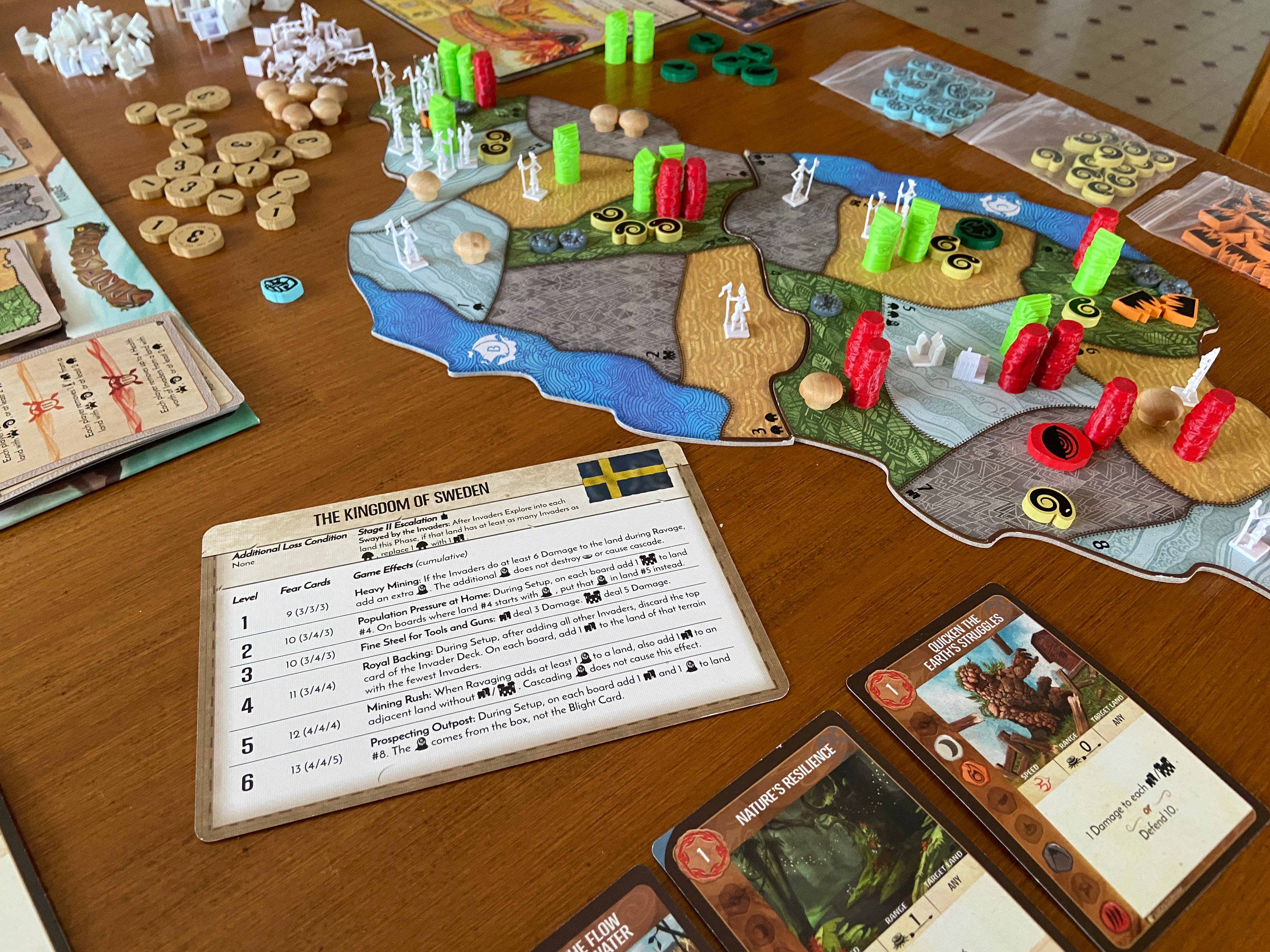
Since we haven’t had a lot of regular gaming, Kim and I have been playing a bit of 2-player Spirit Island. As always this has been a fun game to dig into again. I can see why we don’t play it super-regularly — it’s a bit intense — but whenever we break it out it tends to get a fair amount of play for a while.
The surprise for me was the Serpent Slumbering Beneath the Island spirit. This is a promo spirit, now in the Feather & Flame small box. The promo spirits are quirky and extreme designs, and my experience with them has been a bit meh. Serpent Slumbering is not not extreme, and just from reading the description and the vibes (weak early but crazy-strong late) I didn’t have a ton of optimism, but I’m on a quest to play every spirit in the game once at least. It ended up really engaging me. The twist is that while it is very weak early, virtually all of its initial powers assist other players. So you’re not just trying to survive the early game to build up strength (a common Spirit Island trope), you’re trying to do it by working through your allies until you can bring down the hammer. This is a cool and unique flavor, and it reminds me of the more explicitly cooperative spirits from the Horizons box (which I really like). Spirit Island is a great game, but there is a heads-down-problem-solving element to it, and with many spirit teams the cooperative layer is relatively light; I like the teams where you need to work together more aggressively. I think the difficulty of Serpent Slumbering will still make it a niche flavor, and you want to choose carefully when you play it based on who else is in the game. But I found it really interesting, which has not generally been the case with the promo spirits.
We’ve also been exploring some of the adversaries we haven’t done that much with, including the Tsardom of Russia and Kingdom of Scotland. We’ve also been pushing up the difficulty a bit, usually playing on 8-ish (so usually level 5-ish of the adversaries). I’ve played Spirit Island quite a bit now — probably 100 games — and I have developed a sense of my preferences. I generally prefer the spirits of more moderate difficulty and which don’t have really explosive growth curves, and the simpler and more general-purpose adversaries like England and France. I think the thing that has made Spirit Island so great for me over so many plays is that when I experiment with a different flavor, it’s always interesting. The Tsardom of Russia is tightly tied in with the beasts mechanic (which is a nice nod to Rus’ expansion eastward) and a pretty specific flavor, but when we matched it up with Many Minds Move as One and Wounded Waters Bleeding, both of which use beasts, it was fun. The matchup favored the players, but it was a really different set of tactical problems and it worked really well. The game has just a staggering range once you add in the expansions (Branch and Claw and Jagged Earth are the best I think) and it all just works. That isn’t to say that the there are stronger or weaker spirits and adversaries and certain spirit teams that work well or poorly, and of course there will be occasional mismatches. But it remains regularly satisfying.
Coda
Eugéne Bozza was a prolific 20th century composer of music for woodwinds. Although barely known outside of classical music circles, he’s popular among amateurs these days because his music is accessible both to performers and audiences and is a routine feature of the workshop circuit. As bass clarinetists, we have a fast track to his stuff because Ballade is one of only a small handful of standard repertoire pieces for us. It’s a fun piece that is still on my list to perform someday.
The reason I think of it this week is because of the inscription at the end of the bass clarinet part. Frustratingly I can’t find it in my library right now, but I remember it clearly: it’s dedicated to a few names, I’m guessing students, with a date at the very end of August, 1939 — the last few days of peace for an independent France for the next 6 years. Looking at it in the 21st century, it feels like there is a story here. I haven’t been able to find anything — Bozza’s Wikipedia page is silent on the war years — but that dedication has always struck me.
As always, thanks for reading and please like, subscribe, and share. See you next week!